
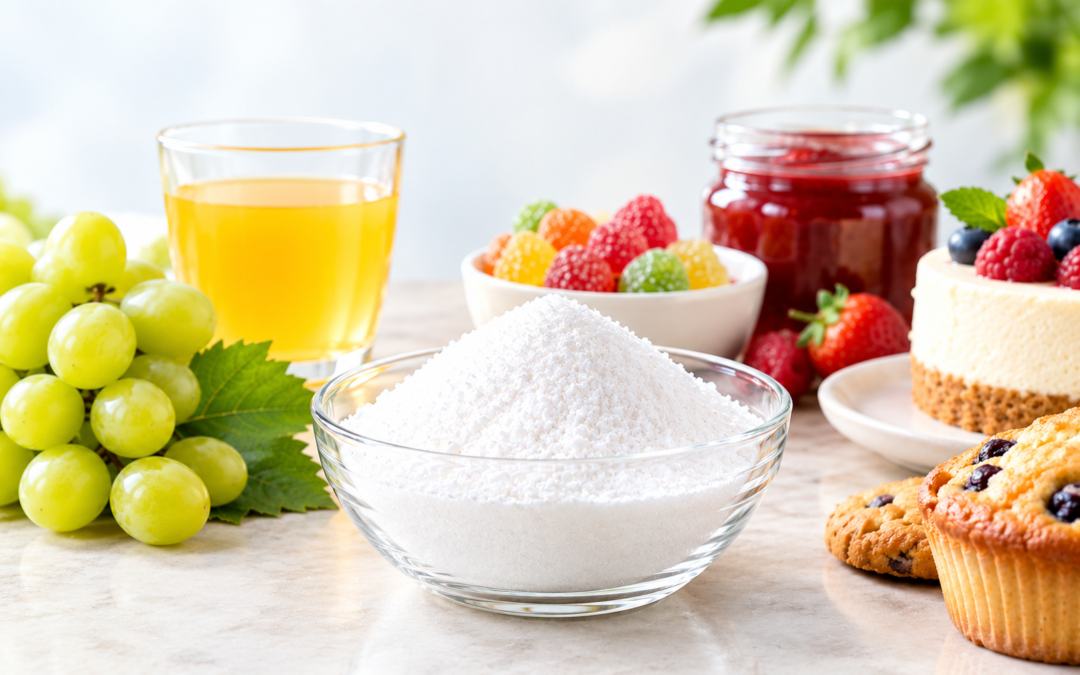
Tartaric Acid (C4H6O6)
Abstract
Tartaric Acid (INS 334 / E334) is a high-quality organic acid widely used in the food and beverage industry as an acidulant and acidity regulator. It is commonly used in beverages, fruit juices, confectionery, bakery products, jams, jellies, sauces, and other food formulations. Its consistent acidity and characteristic sour taste make it a valuable ingredient for food manufacturers. Tartaric Acid is recognized under international food standards such as Codex, JECFA, FCC, and EU regulations.[1]
Introduction
Tartaric Acid is a naturally occurring organic acid with the molecular formula C₄H₆O₆ and a molecular weight of 150.09 g/mol. The form commonly used in the food industry is L(+)-Tartaric Acid, identified by CAS No. 87-69-4, INS 334, and E334. It is generally supplied as a white crystalline powder and is soluble in water.[1-2]
Chemical and Technical Characteristics [1-2]
| English Name | Tartaric Acid |
| Common Industrial Name | L(+)-Tartaric Acid |
| Molecular Formula | C₄H₆O₆ |
| Molecular Weight | 150.09 g/mol |
| CAS No. | 87-69-4 |
| INS No. | 334 |
| E Number | E334 |
| Main Functions | Acidulant / Acidity Regulator / Sequestrant |
| Appearance | White crystalline powder |
| Solubility | Soluble in water |
Why Is Tartaric acid Used in Food? [1-2]
Tartaric acid is primarily used in the food industry as an acidulant and acidity regulator. By reducing the pH, it helps control the acidity of food products and provides a characteristic sour taste.
Its major functions include:
- pH adjustment
- Acidity regulation
- Providing a pleasant sour taste
- Balancing sweetness
- Supporting formulation control
- Acting as a sequestrant in certain applications
Food Applications of Tartaric Acid [3]
- Beverages and Fruit Juices
Tartaric acid is used as an acidulant and acidity regulator in beverages, particularly grape-based beverages and fruit juices, where it helps provide acidity and a characteristic tart flavor. Codex specifically permits L(+)-tartaric acid (INS 334) as an acidity regulator in grape juice.
- Confectionery Products
Tartaric acid is widely used in hard and soft candies, sour confectionery, chewing gum, jellies, and other confectionery products to provide acidity and enhance fruit flavors. Scientific food literature identifies tartaric acid as an acidulant commonly used in hard sour confectionery, jams, jellies, and flavored products.
- Jams, Jellies and Fruit Spreads
Tartaric acid can be used in jams, jellies, marmalades, fruit-based spreads, and fruit fillings as an acidity regulator and acidulant. Codex GSFA includes these products among the food categories in which tartrates are permitted.
- Bakery Products and Cake Mixes
Tartaric acid is used in certain bakery products, cakes, cookies, pies, pancakes, and bakery mixes. Its acidic properties can contribute to acidity control and interactions with alkaline leavening ingredients. Codex lists tartaric acid/tartrates for several bakery categories.
- Cocoa and Chocolate Products
Tartaric acid is permitted in certain cocoa powders, cocoa mixes, chocolate products, and cocoa-based spreads. Codex specifically identifies Tartaric Acid (INS 334) for certain cocoa and chocolate categories.
- Dairy-Based Desserts and Fermented Dairy Products
Tartaric acid/tartrates are permitted in certain dairy-based desserts, flavored milk drinks, and fermented milk products, where they can function as acidity regulators. Codex specifies their use in these categories under defined conditions.
- Sauces, Dressings and Condiments
Tartaric acid is used in certain emulsified and non-emulsified sauces, salad dressings, ketchup, mustard, seasonings, and condiments for acidity control and formulation purposes. Codex lists these applications for tartrates, including INS 334.
- Frozen Desserts and Sorbets
Tartaric acid is also used in edible ices, sherbets, and sorbets, where acidity contributes to the desired flavor profile and overall sensory balance. Codex permits tartrates in this food category under specified conditions.
- Wine and Grape-Based Products
Because tartaric acid naturally occurs in grapes, it has particular importance in wine and grape-based products. Codex recognizes the use of tartrates in grape wines, subject to applicable conditions and good manufacturing practice.
- Food Formulations as a Sequestrant
In addition to its acidulant function, L(+)-tartaric acid is recognized as a sequestrant in international food-additive classifications. This functionality can be relevant in formulations where control of metal ions is required.
International Food Additive Standards [2]
Tartaric acid is identified in the Codex system as: INS 334 – Tartaric Acid
The permitted level of use depends on the specific food category, and therefore a single maximum level cannot be applied to all food products.
Acceptable Daily Intake (ADI) [1]
JECFA safety evaluations for tartaric acid have included an Acceptable Daily Intake (ADI). The reported ADI is 0–30 mg/kg body weight/day.
It is important to distinguish between the ADI and the maximum permitted level in a food product. The ADI refers to an acceptable daily intake relative to body weight, whereas the maximum permitted level refers to the amount permitted in a specific food category.
What to Consider When Buying Tartaric Acid?
When purchasing Tartaric Acid, consider purity and food-grade quality, compliance with international standards, consistent particle size and appearance, reliable packaging, shelf life, Certificate of Analysis (CoA), and supplier reliability. Choosing a trusted supplier helps ensure consistent product quality and stable production performance.
Why Choose Our Tartaric Acid?
Our high-quality Tartaric Acid is an excellent choice for food and beverage manufacturers seeking consistent quality, reliable performance, and compliance with international food standards. It provides effective acidity control and a clean, characteristic sour taste, making it suitable for beverages, confectionery, bakery products, jams, sauces, and other food applications.
Why Buy From Us?
- Consistent quality and purity for reliable industrial performance
- Batch-to-batch consistency to support stable production processes
- Quality documentation, including Certificate of Analysis (CoA) and relevant product specifications
- Reliable supply and professional customer support
- Suitable packaging options for industrial requirements
- Focus on traceability and regulatory compliance
References
- FAO/WHO Joint Expert Committee on Food Additives (JECFA). L(+)-Tartaric Acid, Specification Monograph 1 (2006). JECFA identifies L(+)-Tartaric Acid as INS 334, CAS No. 87-69-4, with established specifications for food-grade use..
- Codex Alimentarius – General Standard for Food Additives (GSFA), CXS 192-1995
- Dziezak, J. D. (2016). Acids: Natural Acids and Acidulants – Tartaric Acid. Encyclopedia of Food and Health, Elsevier.
