
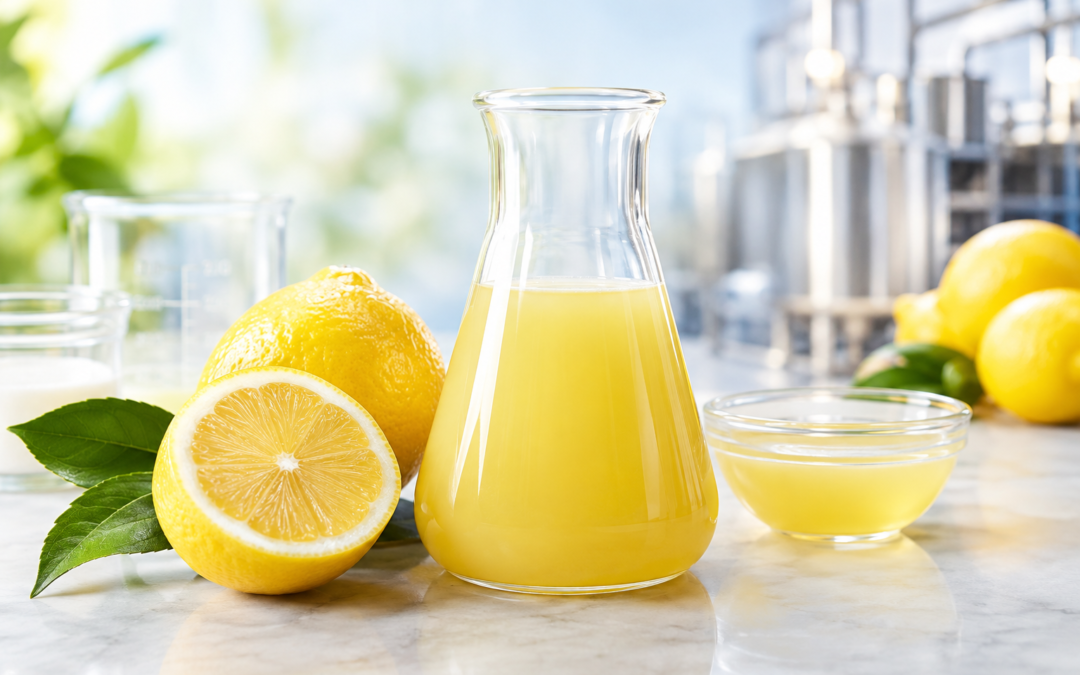
Lemon Juice Concentrate in the Food Industry: Quality Parameters, Processing Technology, Functional Applications, and a Scientific Evaluation of Clarified 400 GPL Lemon Concentrate
Abstract
Lemon juice concentrate is an important industrial ingredient used to provide acidity, citrus flavor, and formulation consistency in beverages, sauces, dressings, confectionery, fruit preparations, and other food products. Its industrial value depends on several interconnected factors, including titratable acidity, soluble solids, clarity, color, flavor, microbiological quality, processing history, storage stability, and suitability for the intended application. Concentration reduces the amount of water transported and stored, while clarification can improve the physical properties of the ingredient for applications requiring a transparent appearance and low suspended-solid content.
This article reviews the chemistry, processing technology, quality requirements, and industrial applications of lemon juice concentrate, with particular attention to the commercial product Lemon Concentrate 400 GPL Clarified, supplied by Gerald McDonald & Company Limited. According to the supplier’s material data sheet dated 15 July 2026, the product contains lemon concentrate as its declared ingredient, has no added preservative, is supplied frozen, and specifies an acidity of at least 400 g/L as anhydrous citric acid, corrected soluble solids of 51.72–57.28 °Brix, and clarity of at least 85% transmittance at 600 nm in the concentrate. Its declared microbiological limits are a total viable count of no more than 1,000 CFU/g and yeast and mould counts of no more than 100 CFU/g.
The product’s principal documented advantages are its high specified acidity, clarified form, defined physicochemical specifications, absence of added preservative, and frozen storage format. These characteristics may be valuable to manufacturers seeking a standardized lemon-derived acidifying and flavoring ingredient. Nevertheless, a data sheet alone cannot establish superiority over all competing products, quantify vitamin C retention, demonstrate sensory preference, or prove shelf-life performance after thawing. The article therefore distinguishes verified product specifications from desirable characteristics that require additional analytical evidence.
Keywords: lemon juice concentrate; clarified lemon concentrate; 400 GPL; citric acid; soluble solids; food processing; juice clarification; industrial ingredient; quality control; food formulation.
- Introduction
Lemon (Citrus limon (L.) Burm. f.) is widely used in food manufacturing because of its distinctive sour taste, characteristic aroma, and content of organic acids and other naturally occurring compounds. Citric acid is the principal contributor to lemon juice acidity, while sugars, volatile aroma compounds, and other constituents influence its overall sensory profile [1,2].
In industrial food production, fresh lemon juice is not always the most practical raw material. Its composition can vary with fruit variety, maturity, growing conditions, and processing. Fresh juice also contains substantial water, which increases transportation and storage requirements.
Lemon juice concentrate addresses several of these challenges by removing part of the water from the juice. This produces an ingredient with a higher concentration of soluble solids and organic acids per unit mass or volume, allowing manufacturers to transport and store less water and formulate products using a concentrated raw material [1,3].
Concentrated lemon juice is not simply a stronger version of fresh lemon juice. Its suitability depends on how concentration and subsequent processing affect acidity, aroma, color, clarity, and other quality attributes. In particular, excessive thermal exposure may cause undesirable changes in citrus juice flavor and color, making processing control an important consideration [1,3].
The objective of this article is to explain the scientific and industrial characteristics of a good lemon juice concentrate, examine its major applications, and assess the documented strengths and limitations of a commercial clarified 400 GPL lemon concentrate.
- Composition and Physicochemical Characteristics of Lemon Juice Concentrate
2.1. Citric acid and titratable acidity
Citric acid is a major organic acid in lemon juice and is responsible for much of its characteristic sourness. In industrial formulations, acidity affects flavor balance, the perceived freshness of a product, and the amount of alkaline or acidic ingredients required to achieve a target formulation [1,2].
Titratable acidity is a particularly important purchasing parameter for lemon concentrate. It measures the amount of base required to neutralize the acids in a sample to a specified endpoint and is commonly expressed as citric acid equivalents.
Two common ways of expressing acidity are:
- Grams per litre (g/L or GPL): acidity expressed as grams of anhydrous citric acid equivalent per litre of product.
- Percentage by mass (% w/w): acidity expressed as grams of anhydrous citric acid equivalent per 100 g of product.
These values should not be compared directly without considering the units and, where necessary, product density.
A high and controlled acidity can help manufacturers standardize sourness and reduce variation between production batches. However, higher acidity does not automatically mean better quality. The appropriate level depends on the intended food, the required flavor profile, and the amount of concentrate used.
2.2. Soluble solids and °Brix
The °Brix scale is based on the refractive index of sucrose solutions. In fruit juices, it is used as an indicator of soluble-solids concentration, although the result is influenced by acids and other dissolved compounds.
For lemon concentrate, Brix should be interpreted alongside acidity rather than as an independent indicator of quality. Two concentrates with similar Brix values may differ in acid concentration and flavor balance.
The Brix-to-acidity ratio can be expressed as:
Brix-to-acidity ratio = corrected °Brix / acidity expressed in the corresponding standardized units.
Because acidity may be reported as GPL or percentage by mass, the ratio must be calculated using the supplier’s specified convention. A ratio should not be compared between suppliers unless the calculation basis is consistent.
2.3. Natural aroma and flavor
Lemon’s characteristic aroma is produced by a mixture of volatile compounds, including terpenes and oxygenated aroma compounds. These compounds contribute to the fresh, citrus-like sensory characteristics of lemon products [2].
Concentration and storage can affect volatile compounds. Consequently, a good concentrate should retain an aroma characteristic of lemon without undesirable cooked, fermented, oxidized, or otherwise atypical notes.
The presence of a lemon-characteristic aroma in a product specification is useful, but it is not equivalent to a complete sensory evaluation. Flavor intensity, bitterness, aroma retention, and consumer acceptance should be assessed when they are important to the final application.
2.4. Clarity and suspended solids
Freshly extracted lemon juice contains suspended particles and colloidal materials, including pectic substances. These components contribute to turbidity and may increase viscosity, complicating filtration and downstream processing.
Enzymatic depectinization and filtration can reduce these materials and produce a clearer juice with lower viscosity. Research by Uçan and colleagues demonstrated the importance of enzymatic treatment and filtration in the production of clarified lemon juice and concentrate [1]. A broader review by Patel and colleagues discusses pectinases and their applications in juice clarification [4].
Clarified concentrate is particularly suitable for products in which visual transparency, low suspended-solid content, or consistent appearance is required. However, clarity is not an absolute measure of nutritional value or overall quality. Cloudy and clarified concentrates can both be appropriate, depending on the product being manufactured.
2.5. Color
Color is another useful quality indicator. Lemon concentrate should have an appearance consistent with its specification and should not exhibit unexplained discoloration.
Citrus juice can undergo color changes during processing and storage. Temperature, oxygen exposure, and processing conditions can influence the stability of its visual and sensory properties [1,3].
Color specifications are particularly useful for manufacturers producing clear beverages, pale sauces, and other products in which the ingredient must not cause unacceptable color changes.
2.6. Vitamin C and other bioactive compounds
Lemon juice naturally contains vitamin C and other compounds, including flavonoids. The composition and bioactive compounds of lemon and lime are discussed in the review by Liu and colleagues [2].
However, the concentration process may affect heat-sensitive compounds. The vitamin C content of a concentrate cannot be calculated reliably from its Brix or acidity alone.
For a manufacturer seeking a vitamin C claim or a nutritionally standardized product, direct analysis of ascorbic acid is necessary. The same principle applies to flavonoids and other bioactive compounds.
Therefore, a high-acidity lemon concentrate should primarily be evaluated as an acidifying and flavoring ingredient unless additional compositional data support broader nutritional claims.
- Industrial Production of Lemon Juice Concentrate
The production of lemon concentrate generally involves several processing stages. The exact process varies between manufacturers and products.
3.1. Raw-material selection and juice extraction
Sound, mature lemons are selected and processed to extract the juice. Seeds and excess pulp are separated according to the intended product specification.
Raw-material quality is important because defects in the fruit can affect flavor, color, and the composition of the resulting juice [1,3].
3.2. Separation and clarification
Depending on the desired product, extracted juice may undergo screening, centrifugation, enzymatic treatment, clarification, and filtration.
Pectolytic enzymes break down pectin and related substances that contribute to turbidity and viscosity. This can improve filtration performance and help produce a clearer, more consistent ingredient [1,4].
The Gerald McDonald data sheet identifies the following clarification-related processing aids:
- Pectinase-degraded material.
- Pectolytic enzymes.
- Rapidase Smart Colour, followed by filtration and degradation as described in the specification.
This information indicates that clarification-related processing aids are associated with the product. It does not, by itself, provide a complete manufacturing flow diagram or establish the precise sequence, dosage, residual activity, or removal of every process aid.
Manufacturers with specific process-aid, enzyme-origin, or allergen requirements should obtain the relevant technical declarations from the supplier.
3.3. Concentration
Concentration removes part of the water from the juice, commonly through evaporation under controlled conditions. Reduced water content decreases the volume that must be transported and stored.
Concentration can also increase the concentration of acids and soluble solids per unit volume. Nevertheless, the processing conditions must be controlled to minimize undesirable flavor and color changes [1,3].
The Codex framework for concentrated fruit juices defines concentration in relation to the physical removal of water and the resulting increase in soluble-solids concentration relative to the corresponding reconstituted juice [5].
3.4. Quality control and freezing
Finished concentrate should be tested against defined specifications. Important measurements include acidity, soluble solids, clarity, color, sensory properties, and microbiological quality.
Storage conditions are also critical. A concentrate supplied frozen requires an appropriate frozen supply chain and handling procedures that maintain its specified quality.
Freezing is a preservation and storage condition; it does not replace the need for suitable manufacturing hygiene, microbiological control, or application-specific shelf-life validation.
- What Makes a Good Industrial Lemon Concentrate?
A high-quality lemon concentrate should meet the technical needs of its intended application. The most useful purchasing criteria include the following.
4.1. Standardized acidity
The acidity should fall within a defined specification and be supported by reliable analytical results. Consistent acidity enables manufacturers to formulate products more reproducibly and control batch-to-batch variation.
4.2. Appropriate soluble-solids concentration
Brix should be suitable for the formulation and consistent with the declared concentrate type. Brix is especially useful when calculating dilution, evaluating raw-material consistency, and comparing batches.
4.3. Suitable clarity and color
Clear beverage manufacturers may prefer a clarified concentrate with low turbidity and controlled color. In contrast, products intended to deliver a cloudy, juice-like appearance may require a different specification.
The correct choice is therefore application-dependent rather than universally defined.
4.4. Characteristic lemon flavor
A suitable concentrate should have a recognizable lemon flavor and aroma without unacceptable bitterness or off-notes. Where sensory performance is commercially important, manufacturers should evaluate the concentrate after dilution and in the actual food formulation.
4.5. Microbiological quality
A good specification establishes appropriate microbiological criteria and identifies the analytical methods or sampling basis used.
Total viable count, yeast, and mould results are useful indicators of microbiological quality. They do not independently establish sterility, the absence of every pathogen, or the safety of the final food under all storage conditions.
4.6. Controlled storage and shelf life
Storage instructions should be clear and supported by stability data. Buyers should verify the permitted storage temperature, expected shelf life, packaging conditions, and handling requirements after delivery and opening.
4.7. Traceability and documentation
A technically suitable ingredient should be accompanied by appropriate documentation, including:
- A current material data sheet.
- A batch-specific Certificate of Analysis (CoA).
- Food-safety and microbiological documentation.
- Relevant contaminant and pesticide-residue information, where required.
- Allergen and process-aid declarations, where applicable.
- Storage and shelf-life information.
- Country-of-origin and traceability information.
- Documentation relevant to the destination market and intended application.
The data sheet is an important starting point, but it should not be treated as a substitute for batch-specific analytical evidence.
- Industrial Applications of Lemon Juice Concentrate
Lemon concentrate can be used in multiple food categories. The optimum concentration and addition level depend on the product’s target acidity, flavor, color, processing conditions, and applicable regulations.
5.1. Soft drinks and citrus beverages
Lemon concentrate can provide sourness and citrus flavor in carbonated drinks, still beverages, lemonades, and beverage syrups.
Its defined acidity is particularly useful for standardizing formulations. However, manufacturers should evaluate the effect of the concentrate on sweetness-acidity balance, aroma, and final pH.
The appropriate dosage should be determined through pilot formulation and sensory testing rather than using a universal percentage.
5.2. Fruit drinks and juice blends
Lemon concentrate can adjust acidity and contribute citrus flavor in fruit beverages and blended juices.
In these products, acidity influences the perception of sweetness and fruit flavor. The concentrate must be compatible with the other juice ingredients, and its use should comply with the applicable product identity and labeling rules.
The United States regulation for standardized lemon juice, for example, distinguishes lemon juice made directly from fruit from lemon juice prepared from concentrate [6]. Manufacturers must follow the requirements of the jurisdiction where the finished product is marketed.
5.3. Sauces, dressings, and condiments
Lemon concentrate can be used in salad dressings, sauces, marinades, and condiment formulations where a controlled acidic profile is required.
A clarified ingredient may be especially useful when visible particles are undesirable. Nevertheless, acidity alone does not establish the safety or shelf life of a sauce. The final formulation must be assessed for pH, water activity where relevant, processing conditions, packaging, and microbiological stability.
5.4. Jams, marmalades, and fruit preparations
Lemon juice and lemon-derived ingredients can contribute acidity to fruit preparations and confectionery systems. Clarified lemon juice has also been investigated as an acidifying ingredient in fruit processing [1].
The appropriate amount depends on the fruit system, sugar content, pectin characteristics, and intended texture. Manufacturers should not assume that the concentrate will automatically provide the required gel strength or preservation effect.
5.5. Confectionery and bakery applications
Lemon concentrate can contribute acidity and flavor to candies, fillings, icings, and selected bakery products.
Its suitability depends on the water content of the formulation, thermal exposure, interactions with other ingredients, and the desired sensory profile. Heat-processing stability should be verified for the actual application.
5.6. Ready meals and prepared foods
Lemon concentrate can be incorporated into selected prepared foods, sauces, and marinades to provide a standardized lemon-derived acidic component.
The use level should be selected according to the desired flavor and the technical requirements of the final food. It should not be assumed to function as a complete replacement for all other acidulants, preservatives, or process controls.
- Evaluation of the Commercial Product: Lemon Concentrate 400 GPL Clarified
6.1. Product identification
The material data sheet supplied for this evaluation identifies the product as follows [8]:
| Parameter | Information stated in the data sheet |
| Product name | Lemon Concentrate 400 GPL Clarified |
| Supplier | Gerald McDonald & Company Limited |
| Product code | 0631.06 |
| Issue | 9 |
| Document date | 15 July 2026 |
| Declared ingredient | Lemon concentrate |
| Preservative | None |
| Storage form | Frozen |
| Appearance | Clear, viscous liquid ranging from yellow to fawn |
| Aroma and flavor | Characteristic of lemon |
| Intended use | Raw material for foods and beverages |
These are supplier-declared characteristics, not independent analytical findings. They establish the identity and declared technical profile of the product but do not independently verify every batch.
6.2. Declared physicochemical specifications
| Parameter | Specification | Industrial significance |
| Uncorrected soluble solids | 46.0–51.0 °RS | Supplier-defined refractometric measurement |
| Corrected soluble solids | 51.72–57.28 °Brix | Useful for formulation and batch consistency |
| Acidity, % w/w as anhydrous citric acid | 31.67–35.00% | Indicates a highly acidic concentrate |
| Acidity, GPL | At least 400 g/L | Supports controlled acidification and dosage calculations |
| Clarity, concentrate, 600 nm, 1 cm | At least 85% transmittance | Indicates a specified level of optical clarity |
| Clarity at single strength, 600 nm, 1 cm | At least 98% transmittance | Supports evaluation of clarity after the specified preparation |
| Color at single strength, 420 nm, 1 cm | a ≤ 0.30, as stated in the data sheet | Provides a defined instrumental color criterion |
Important interpretation: The product’s Brix and acidity ranges are supplier specifications. They should not be interpreted as evidence that every batch has been independently tested or that the product necessarily outperforms a competing concentrate.
The data sheet also lists typical, non-controlling characteristics: pH 1.6–2.8, corrected Brix-to-acidity ratio 1.49–1.79, single-strength corrected Brix of 8.0 °Brix, uncorrected Brix of 7.1 °RS, juice content of 777% v/v under the cited BSDA Code of Practice, and apparent density of 1.238–1.270 g/mL at 20 °C.
Because these values are explicitly described as typical rather than controlling attributes, buyers should request confirmation of the actual batch values whenever they are critical to production.
6.3. Microbiological specifications
| Parameter | Supplier specification |
| Total viable count (TVC) | ≤ 1,000 CFU/g |
| Yeast and mould | ≤ 100 CFU/g |
These limits provide defined microbiological purchasing criteria. Their adequacy must be considered in relation to the applicable legal requirements, analytical methods, intended use, and processing of the finished food.
The specification does not, on its own, demonstrate the absence of every foodborne pathogen. Buyers requiring pathogen-specific assurance should request the relevant documentation.
6.4. Storage and shelf life
The data sheet states that the product is supplied frozen and gives a storage period of 12 months at −18 °C, measured from delivery to retesting to confirm continued suitability.
It lists no defined storage duration at the higher temperature categories shown in the table.
This is an important operational consideration. The product should be handled within the stated frozen-storage framework, and manufacturers should confirm thawing, post-thaw storage, resealing, and permitted holding times with the supplier.
The 12-month period is a period to retesting for confirmation of suitability, as described in the data sheet; it should not automatically be interpreted as a guarantee that the product remains unchanged under every handling condition.
- What Are the Main Advantages of This Particular Concentrate?
7.1. High specified acidity
The product declares acidity of at least 400 g/L, with a specified mass-based acidity range of 31.67–35.00%.
This is useful for manufacturers who need a concentrated lemon-derived acidifying ingredient. It allows formulation calculations to be based on a defined acidity specification rather than on an assumed acidity of fresh lemon juice.
For purchasing purposes, the batch-specific acidity should be verified through the CoA.
7.2. Clarified form for clear products
The product’s clarified designation and specified transmittance values are relevant to manufacturers of clear beverages, syrups, and other products in which a low-turbidity ingredient is preferred.
The main benefit is technological compatibility with applications that require visual clarity. This is not proof that clarified concentrate is nutritionally superior to cloudy concentrate.
7.3. Declared absence of added preservative
The data sheet states that no preservative is used.
This may be attractive to manufacturers seeking an ingredient without added chemical preservatives, subject to the formulation’s regulatory and labeling requirements.
However, “no preservative added” does not mean “preserved under all conditions” or “microbiologically sterile.” The product is supplied frozen, and the required storage and handling conditions remain important.
7.4. Defined acidity, Brix, clarity, and microbiological limits
The combination of specified physicochemical and microbiological parameters makes the product easier to assess against a manufacturer’s raw-material purchasing specification.
For example, a beverage manufacturer can establish acceptance limits for acidity and Brix and use batch documentation to reduce the risk of formulation variation.
The value lies in the availability of defined parameters; actual batch consistency should still be confirmed from historical CoAs and incoming-quality-control results.
7.5. Frozen supply format
Frozen supply is relevant for concentrated fruit ingredients because storage conditions can influence continued suitability and quality.
The supplier’s specified storage temperature gives buyers a defined basis for planning frozen transport, receiving, and inventory management.
Its practical advantage depends on the buyer’s cold-chain capacity, energy costs, delivery frequency, and production schedule.
7.6. Lemon-derived ingredient with multiple formulation possibilities
The declared ingredient is lemon concentrate, and the supplier identifies foods and beverages as intended applications.
This provides flexibility for manufacturers who want to investigate its use in acidic beverages, sauces, fruit preparations, and other products where a concentrated lemon ingredient is appropriate.
Nevertheless, the exact dosage, sensory performance, compatibility, and final product labeling must be established for each application.
- Comparison Between an Ideal Industrial Lemon Concentrate and the Supplied Product
A scientifically meaningful comparison should distinguish between characteristics documented in the supplier’s specification and additional information that a buyer should request.
| Quality criterion | What a good industrial concentrate should provide | Assessment of the supplied product |
| Acidity | Defined, application-appropriate acidity | Specified at ≥400 GPL and 31.67–35.00% w/w |
| Soluble solids | Defined and reproducible Brix | Corrected range of 51.72–57.28 °Brix |
| Clarity | Suitable for the intended visual appearance | Specified transmittance of ≥85% in concentrate and ≥98% at single strength |
| Color | Controlled and appropriate to the formulation | Single-strength instrumental color limit is stated |
| Flavor | Characteristic lemon flavor without unacceptable defects | Characteristic lemon flavor and aroma are declared; independent sensory data are not supplied |
| Added preservatives | Clearly declared | No preservative is declared |
| Microbiological quality | Defined acceptance limits and suitable testing | TVC and yeast/mould limits are specified |
| Storage | Clear temperature and time requirements | Frozen; 12 months at −18 °C to retesting for suitability |
| Batch consistency | Supported by historical and batch-specific results | Requires CoA and batch-history verification |
| Vitamin C | Quantified if relevant to the product claim | No vitamin C value is stated |
| Pesticide residues and contaminants | Appropriate documentation for intended market | Not detailed in the supplied specification |
| Allergen and process-aid status | Clear declarations where relevant | Further supplier documentation is advisable |
| Post-thaw stability | Defined handling and holding instructions | Not established by the supplied sheet |
| Sensory superiority | Demonstrated through comparative evaluation | No comparative sensory study is provided |
| Price-performance | Evaluated at the delivered cost per unit of useful acidity | Requires quotation and a like-for-like competitor comparison |
This comparison supports a favorable assessment of the product’s documented technical definition, particularly its acidity and clarity specifications. It does not justify claiming that it is the best concentrate available on the market.
A competitor could offer equivalent acidity and clarity, better aroma retention, a different storage format, or lower total delivered cost. A valid purchasing decision requires comparable data from the actual products under consideration.
- How Should a Food Manufacturer Calculate the Required Dosage?
The appropriate dosage should be calculated according to the target acidity of the final formulation.
For an ingredient with a verified acidity expressed in grams per litre as anhydrous citric acid, a simplified starting calculation is:
Required concentrate volume (L) = target acid equivalent (g) / concentrate acidity (g/L).
For example, if a formulation requires 10 g of citric acid equivalent and the concentrate has a verified acidity of 400 g/L:
10 g ÷ 400 g/L = 0.025 L = 25 mL.
This is a theoretical acid-equivalent calculation. It is not a recommended universal addition rate for beverages or other foods.
Actual formulation requires consideration of the final batch volume, the acidity contributed by other ingredients, the desired sensory profile, the relevant measurement basis, and the effect of the concentrate’s own soluble solids.
Where acidity is expressed on a mass basis, density must be considered when converting between mass and volume. A validated laboratory method and pilot-scale formulation should be used to confirm the actual dosage.
- Recommended Quality-Control Tests Before Industrial Use
The following testing plan can help determine whether the concentrate is suitable for a specific production process.
10.1. Incoming raw-material assessment
For each batch, verify:
- Product identity and batch number.
- Corrected Brix.
- Titratable acidity and the reporting basis.
- Appearance and characteristic lemon aroma.
- Clarity and color where relevant.
- Total viable count, yeast, and mould according to the agreed specification.
- Storage temperature and condition on receipt.
- Packaging integrity and traceability.
10.2. Additional compositional testing
Depending on the application, consider:
- Ascorbic acid content.
- Relevant pesticide residues.
- Heavy metals and other contaminants where required by the risk assessment or applicable law.
- Residual process aids, if relevant.
- Additional sensory and compositional measurements needed for product authenticity or labeling.
These are recommended purchasing checks, not claims that the supplied product fails to meet any requirement.
10.3. Formulation trials
Prepare pilot formulations using the concentrate at different addition levels. Measure:
- Final pH and titratable acidity.
- Brix and, where appropriate, the Brix-to-acidity relationship.
- Color and turbidity.
- Sensory acceptance.
- Compatibility with other ingredients.
- Processing performance.
- Microbiological stability under the intended conditions.
The purpose is to determine the most suitable dosage and to identify any changes in flavor, appearance, or stability caused by the concentrate in the actual food matrix.
10.4. Shelf-life validation
The finished food should be evaluated under the intended storage conditions. Relevant measurements may include acidity, pH, color, flavor, turbidity, packaging integrity, and microbiological quality.
The shelf life of the final food cannot be inferred solely from the frozen storage period specified for the concentrate.
- Important Regulatory and Labeling Considerations
The regulatory suitability of lemon concentrate depends on the destination market and the intended food category.
The Codex framework provides an international reference for fruit juice identity and composition, including concentrated fruit juices [5]. The United States has specific requirements for standardized lemon juice and labeling of juice made from concentrate [6]. The United States Department of Agriculture also publishes grades and standards for concentrated lemon juice for manufacturing, including quality considerations such as flavor, color, defects, and reconstitution [7].
These examples illustrate why manufacturers should not assume that one specification automatically establishes compliance in every country.
For a finished product, manufacturers should confirm:
- Whether the ingredient is permitted for the intended application.
- Whether the ingredient declaration and product name are appropriate.
- Whether the use level complies with applicable requirements.
- Whether the finished product meets relevant acidity, composition, and microbiological criteria.
- Whether any nutrition or health-related claims are supported by analytical evidence and legally permitted.
The statement that the supplier produces its product in accordance with current UK legislation and EC directives is a supplier declaration in the data sheet. It should not be interpreted as a substitute for confirming the specific requirements of the destination market.
- Why Should a Food Manufacturer Consider Buying This Concentrate?
From an industrial purchasing perspective, the strongest reasons to consider this product are technical rather than promotional.
First, the declared acidity provides a useful basis for calculating acid-equivalent additions. Second, the clarified form and transmittance criteria are relevant to products requiring visual clarity. Third, the specified Brix range and microbiological limits support the establishment of incoming-material acceptance criteria. Fourth, the absence of declared added preservative may suit particular formulation and labeling objectives. Finally, the frozen storage specification provides a defined basis for supply-chain planning.
These benefits may reduce formulation uncertainty when the product is used within its specification and supported by reliable batch documentation.
However, purchasing decisions should also consider the delivered price, shipping conditions, frozen-storage capacity, product loss during handling, dosage per batch, and the performance of the ingredient in the intended formulation.
A useful commercial comparison is the cost of achieving the required acidity in the finished product, rather than simply the price per kilogram of concentrate. This approach allows buyers to compare ingredients with different acidity levels on a more meaningful basis.
The supplied product’s data sheet does not include a market price, a comparative sensory study, a vitamin C assay, or a direct performance comparison against competing concentrates. These factors should therefore be investigated separately before making a final purchasing decision.
- Discussion
The quality of lemon concentrate is determined by the interaction of chemical composition, processing, sensory properties, microbiological quality, and storage conditions. No single measurement is sufficient to establish overall superiority.
Acidity is particularly important for industrial formulation, but a high-acidity product may not be optimal for every application. Similarly, clarity is desirable in transparent beverages but may be unnecessary or undesirable in products intended to retain a cloudy, juice-like appearance.
The supplied 400 GPL clarified lemon concentrate has a defined technical profile, with specified acidity, soluble solids, clarity, color, microbiological limits, and frozen storage conditions. These features make it a reasonable candidate for evaluation by manufacturers who need a concentrated, clarified lemon-derived ingredient.
The most important qualification is that the data sheet describes specifications rather than demonstrating comparative superiority. Its declared characteristics support a technical assessment of potential suitability, while batch-specific CoAs, application trials, stability studies, and regulatory documentation are needed to complete the evaluation.
A rational ingredient-selection framework is therefore:
Ingredient selection = Chemical specifications + Sensory suitability + Microbiological quality + Processing compatibility + Storage stability + Regulatory compliance + Delivered cost.
This framework enables buyers to make decisions based on measurable performance rather than brand recognition or individual specifications in isolation.
- Conclusion
Lemon juice concentrate is a versatile industrial ingredient that can provide acidity and lemon flavor in beverages, sauces, dressings, fruit preparations, confectionery, and other food products. Its usefulness depends on controlled acidity, appropriate soluble-solids concentration, suitable clarity and color, characteristic flavor, microbiological quality, and correct storage.
The commercial Lemon Concentrate 400 GPL Clarified evaluated in this article has several documented features that may be advantageous to food manufacturers. These include a declared acidity of at least 400 GPL, corrected Brix of 51.72–57.28, defined clarity requirements, stated microbiological limits, no declared added preservative, and a frozen storage specification.
The product is particularly worth evaluating for formulations that require a concentrated lemon-derived acidifying ingredient and a clarified appearance. Its suitability should nevertheless be confirmed through batch-specific analytical documentation and trials in the intended food.
The available data sheet does not establish that this concentrate is universally superior to competing products, nor does it demonstrate a specific vitamin C content, clinical health benefit, or guaranteed shelf life in every finished formulation.
The most scientifically defensible purchasing decision is therefore not simply to ask which concentrate has the highest acidity or the clearest appearance, but:
Does the actual batch meet the required chemical, sensory, microbiological, storage, and regulatory specifications, and does it deliver the desired performance at an acceptable total cost in the intended food application?
References
- Uçan, F., Akyildiz, A., & Ağçam, E. (2014). Effects of different enzymes and concentrations in the production of clarified lemon juice. Journal of Food Processing, 2014, Article 215854. https://doi.org/10.1155/2014/215854
- Liu, S., Li, S., & Ho, C.-T. (2022). Dietary bioactives and essential oils of lemon and lime fruits. Food Science and Human Wellness, 11(4), 753–764. https://doi.org/10.1016/j.fshw.2022.03.001
- Lorente, J., Vegara, S., Martí, N., Ibarz, A., Coll, L., Hernández, J., Valero, M., & Saura, D. (2014). Chemical guide parameters for Spanish lemon (Citrus limon (L.) Burm.) juices. Food Chemistry, 162, 186–191. https://doi.org/10.1016/j.foodchem.2014.04.042
- Patel, V. B., Chatterjee, S., & Dhoble, A. S. (2022). A review on pectinase properties, application in juice clarification, and membranes as immobilization support. Journal of Food Science, 87(8), 3338–3354. https://doi.org/10.1111/1750-3841.16233
- Codex Alimentarius Commission. (2005, as amended). General Standard for Fruit Juices and Nectars (CXS 247-2005). Food and Agriculture Organization of the United Nations and World Health Organization. https://www.fao.org/input/download/standards/10254/CXS_247e.pdf
- United States Food and Drug Administration. 21 CFR § 146.114 — Lemon juice. Electronic Code of Federal Regulations. https://www.ecfr.gov/current/title-21/section-146.114
- United States Department of Agriculture, Agricultural Marketing Service. United States Standards for Grades of Concentrated Lemon Juice for Manufacturing. https://www.ams.usda.gov/grades-standards/concentrated-lemon-juice-manufacturing-grades-and-standards
- Gerald McDonald & Company Limited. (2026, July 15). Material Data Sheet: Lemon Concentrate 400gpl Clarified. Product code 0631.06, Issue 9. Supplier technical document provided for this evaluation.
