
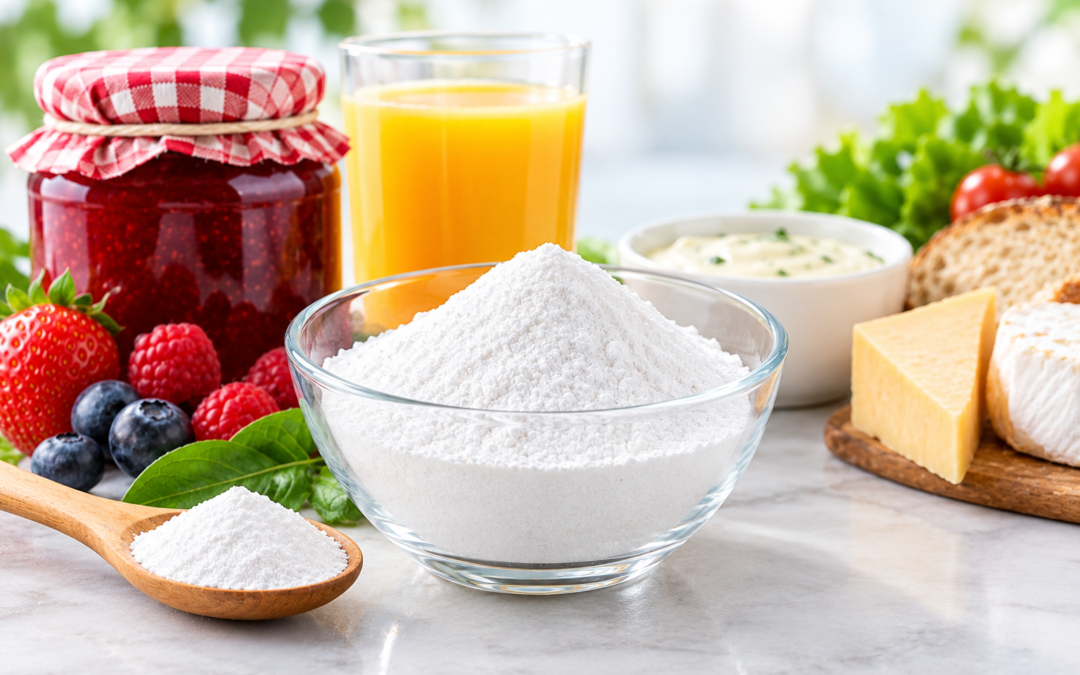
Potassium Sorbate (C6H7KO2)
Abstract
Potassium sorbate (INS 202 / E202) is a widely used food preservative that inhibits the growth of molds and yeasts, helping extend the shelf life of beverages, fruit products, sauces, and other foods. Its effectiveness depends on factors such as pH, formulation, and storage conditions. Permitted use levels vary by food category and applicable regulations, including Codex Alimentarius and European Union legislation. EFSA established a group Acceptable Daily Intake (ADI) of 11 mg/kg body weight per day, expressed as sorbic acid.[1-2]
Introduction
Potassium sorbate (INS 202 / E202) is a widely used food preservative in the food and beverage industry. It is the potassium salt of sorbic acid and is primarily used to inhibit the growth of molds and yeasts, helping maintain product quality and extend shelf life. It is commonly applied in fruit products, beverages, sauces, bakery products, and selected dairy products, subject to applicable regulations. Its antimicrobial effectiveness depends on factors such as pH, food composition, and storage conditions. The permitted use levels vary according to food category and relevant international or national standards, including Codex Alimentarius and European Union regulations.[1-2]
Chemical and Technical Characteristics [3]
| English Name | Potassium Sorbate |
| Molecular Formula | C₆H₇KO₂ |
| CAS No. | 24634-61-5 |
| INS No. | 202 |
| E Number | E202 |
| Solubility | Freely soluble in water |
| Appearance | White to off-white crystalline powder or granules |
Applications of Potassium Sorbate in the Food Industry [4]
Potassium sorbate is the potassium salt of sorbic acid. It is primarily used as a preservative to inhibit the growth of many molds and yeasts. It is generally more effective in acidic food systems, where a greater proportion of sorbic acid is present in its undissociated form.
- Jams, Jellies, and Fruit Products
Potassium sorbate may be used in permitted fruit preparations, jams, jellies, and similar products to help control mold and yeast growth and extend shelf life. Its performance depends on pH, water activity, processing conditions, and storage.
- Beverages and Fruit Juices
Potassium sorbate is used in certain acidic beverages and fruit-based drinks to inhibit spoilage yeasts and molds. Its permitted use and maximum level depend on the specific beverage category and the applicable regulations.
- Sauces, Salad Dressings, and Condiments
In certain sauces, dressings, and condiments, potassium sorbate helps control spoilage caused by molds and yeasts. Its suitability depends on formulation, pH, processing, and storage conditions.
- Cheese and Selected Dairy Products
Where specifically permitted, potassium sorbate may be used in certain cheese products or surface treatments to control mold growth. Authorization varies according to the type of cheese, method of application, and relevant food additive regulations.
- Bakery and Confectionery Products
Potassium sorbate may be used in permitted bakery products and certain confectionery formulations to help prevent mold growth and improve shelf-life stability. Its effectiveness and permitted concentration depend on the product and its formulation.
Important regulatory note: These are examples of potential food applications, not confirmation that potassium sorbate is authorized in every product within each category. The exact food category, applicable provisions, and any restrictions must be checked before use.
Mechanism of Action and Technical Advantages [5]
Potassium sorbate acts through the sorbic acid–sorbate equilibrium in food. Undissociated sorbic acid generally plays an important role in antimicrobial activity; therefore, potassium sorbate is usually more effective in acidic products.
Its main technical advantages include:
- Inhibiting the growth of many molds and yeasts.
- Helping extend product shelf life and reduce microbial spoilage.
- Supporting preservation in a wide range of suitable food formulations.
- Providing formulation flexibility when used at appropriate levels under applicable regulations.
Factors affecting its effectiveness: pH, water activity (aw), temperature, initial microbial load, type of microorganism, product composition, and packaging conditions.
International Food Additive Standards [6]
There is no single maximum permitted level of potassium sorbate that applies to all foods. Permitted use depends on the food category, applicable regulatory conditions, and the destination market.
The Codex General Standard for Food Additives, CXS 192-1995, specifies conditions for the use of food additives by food category.
Potassium sorbate belongs to the sorbates group, which includes:
- Sorbic acid (INS 200)
- Potassium sorbate (INS 202)
- Calcium sorbate (INS 203)
In provisions defined at the group level, the maximum level applies to the total content of the additives included in that group. Some provisions express the maximum level as sorbic acid, rather than as the mass of potassium sorbate added.
Acceptable Daily Intake (ADI) [7]
Two important authorities have evaluated the safety of sorbic acid and its salts: JECFA and the European Food Safety Authority (EFSA).
- JECFA: A group ADI of 0–25 mg/kg body weight per day, expressed as sorbic acid, was established for sorbic acid and its sodium, potassium, and calcium salts.
- EFSA (2019): Following an updated evaluation of reproductive toxicity data, EFSA established a group ADI of 11 mg sorbic acid/kg body weight per day for sorbic acid (E200) and potassium sorbate (E202).
These values come from different scientific assessments and should not be treated as identical or interchangeable regulatory limits. The applicable regulatory position should be checked for the target market.
Quality Standards and Purchasing Criteria for Food-Grade Potassium Sorbate [8]
When purchasing or selling potassium sorbate for food applications, buyers should evaluate more than price. The product should meet the relevant food-grade specifications and regulatory requirements.
| Purchasing criterion | Why it matters |
| Food-grade status | Confirms suitability for the intended food application, subject to applicable requirements. |
| Purity / assay | Verifies compliance with the relevant identity and purity specification. |
| Certificate of Analysis (CoA) | Provides analytical results for the specific production batch. |
| Identity testing | Confirms that the material is potassium sorbate. |
| Heavy metals and impurities | Helps verify compliance with applicable impurity limits. |
| Appearance and solubility | Confirms conformity with the product’s technical specification. |
| Packaging and shelf life | Supports product integrity, traceability, and appropriate storage. |
| Regulatory compliance | Confirms suitability for the intended application and destination market. |
Why Choose Our Potassium Sorbate?
Our potassium sorbate offers a reliable solution for controlling mold and yeast growth and helping extend the shelf life of food products. When purchasing potassium sorbate, customers should consider product purity, food-grade quality, consistency, a batch-specific Certificate of Analysis (CoA), proper packaging, and compliance with relevant food safety standards. We are committed to providing quality products and dependable service to meet our customers’ needs.
References
- Sofos, J. N., & Busta, F. F. (1981). Antimicrobial Activity of Sorbate. Journal of Food Protection, 44(8), 614–622.
- EFSA Panel on Food Additives and Flavourings (2019). EFSA Journal, 17(3), 5625.
- WHO/JECFA – Potassium Sorbate — chemical identity, CAS number, INS number, functional class, and safety evaluation
- Codex GSFA – Sorbates
- Liewen, M. B., & Marth, E. H. (1985). “Growth and Inhibition of Microorganisms in the Presence of Sorbic Acid: A Review.” Journal of Food Protection, 48(4), 364–375.
- Codex GSFA Online — General Standard for Food Additives
- JECFA — Potassium Sorbate. WHO/JECFA database.
- FAO/JECFA — Food Additive Specifications.
