
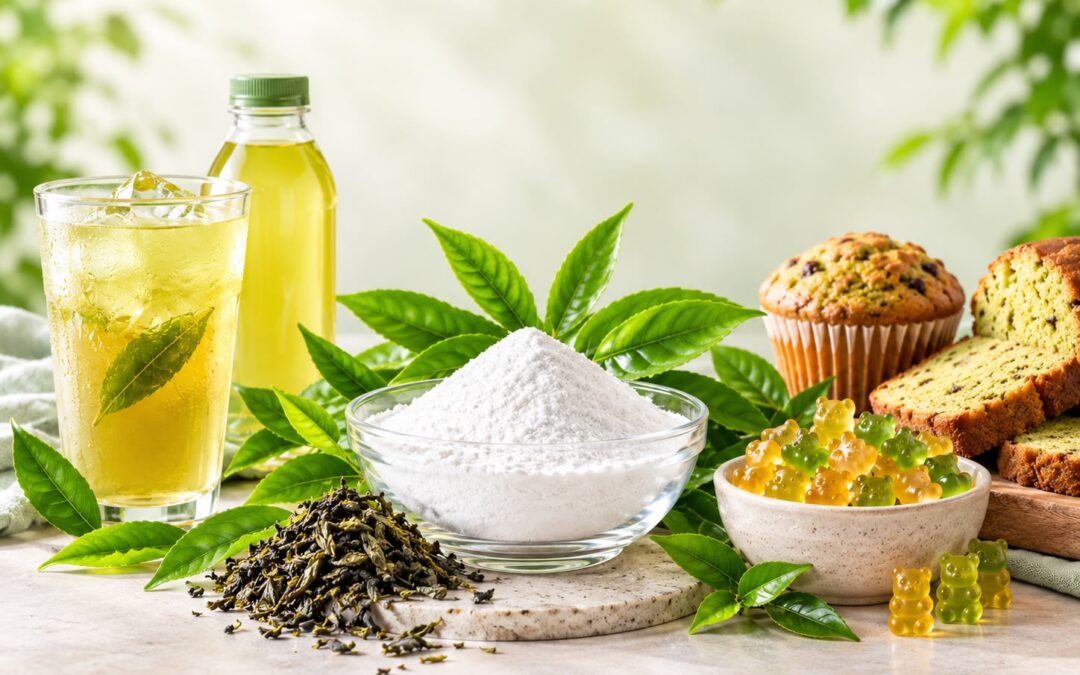
Advanced L-Theanine Applications in Foods and Beverages: Chemical Form, Bioavailability, Food-Matrix Interactions, Processing Stability, Functional Properties, and the Application of Suntheanine®
Abstract
L-Theanine (γ-glutamylethylamide) is a naturally occurring non-proteinogenic amino acid predominantly associated with the tea plant Camellia sinensis. It contributes to the characteristic umami taste of tea and has attracted substantial scientific and commercial interest because of its potential effects on relaxation, attention, stress response, mood, and sleep. [12,13]
The successful incorporation of L-theanine into foods and beverages requires simultaneous consideration of chemical identity, stereochemical purity, dose, absorption, formulation compatibility, sensory properties, processing conditions, stability, and regulatory requirements. Unlike mineral fortificants, the principal challenge with L-theanine is not the delivery of an essential mineral but the development of a standardized bioactive ingredient whose identity, purity, dose, and biological effects can be reliably controlled. [6,7,9,11]
Recent systematic reviews and meta-analyses provide evidence for selected effects of L-theanine on cognitive performance, stress-related outcomes, and sleep. A 2026 systematic review and meta-analysis of 31 randomized controlled trials involving 1,168 participants reported a significant improvement in choice reaction time following a single 200-mg dose administered 30–60 min before cognitive testing. The reduction in acute stress was modest and anxiety effects were inconsistent. No serious adverse events were reported in the included trials. [1,3]
A 2025 systematic review and meta-analysis involving 897 participants reported significant improvements in subjective sleep-onset latency, daytime dysfunction, and overall subjective sleep quality, although the authors emphasized the limited number of studies using pure L-theanine. [2]
Commercial L-theanine ingredients are available in powder and formulated delivery systems. The current Taiyo product information supplied for this project identifies Suntheanine® as patented enzymatically produced L-theanine and specifies a pure L-theanine powder containing 98% L-theanine. [15,16]
This review evaluates L-theanine from the perspectives of chemistry, production, bioavailability, food-matrix interactions, sensory properties, formulation, analytical quality control, functional applications, and commercial product assessment. Particular attention is given to the comparison between scientifically established evidence and manufacturer-specific claims concerning Suntheanine®. [1,2,6,7,9,11]
Keywords: L-theanine; γ-glutamylethylamide; Camellia sinensis; functional food; nutraceutical; bioavailability; cognition; stress; sleep; stereochemistry; Suntheanine®; food matrix.
- Introduction
L-Theanine is a unique non-proteinogenic amino acid naturally associated with tea plants, particularly Camellia sinensis. It contributes to the characteristic umami-related sensory properties of tea and is now commercially produced for use in dietary supplements, functional foods, beverages, and other nutraceutical applications. [12,13]
From a food-science perspective, successful L-theanine formulation requires consideration of several factors:
- Chemical identity.
- L-theanine assay.
- Enantiomeric purity.
- Dose.
- Oral absorption.
- Compatibility with the food matrix.
- Sensory properties.
- Processing stability.
- Storage stability.
- Regulatory suitability.
- Cost.
- Evidence supporting the intended physiological claim.
Unlike conventional nutrient fortification, the objective is generally not to maximize chemical solubility alone. Instead, the formulation should provide a controlled quantity of L-theanine while maintaining product quality and delivering the intended functional dose. [6,7]
- L-Theanine Requirements and the Concept of Active L-Theanine
When purchasing L-theanine, the mass of the powder should not automatically be interpreted as the mass of active L-theanine. [15]
For example, a commercial powder containing 98% L-theanine theoretically provides: [15]
500 mg powder × 0.98 = 490 mg L-theanine
Therefore, experimental doses should preferably be calculated according to the certified active L-theanine content. [15]
This is particularly important when comparing commercial ingredients with clinical studies.
The current Taiyo specification supplied for this project identifies its product as: [15]
Pure L-Theanine Powder (98% L-theanine)
and lists product code 272179 for a 10-kg package. [15]
For scientific applications, however, the specification should ideally include not only total assay but also stereochemical purity and batch-specific analytical results. [9,10,15]
- Natural Sources and Commercial Forms of L-Theanine
3.1 Tea-derived L-Theanine
L-Theanine is naturally present in tea leaves and is considered one of the characteristic non-protein amino acids of tea. [12,13]
Its concentration varies according to:
- tea cultivar,
- plant age,
- leaf position,
- growing conditions,
- environmental stress,
- harvesting conditions,
- processing method.
Research on tea plants indicates that L-theanine is biosynthesized from glutamate and ethylamine and is particularly associated with young tissues and roots. [12,13]
3.2 Commercial L-Theanine
Commercial L-theanine can be produced by:
- extraction from tea,
- chemical synthesis,
- enzymatic transformation,
- microbial/biotechnological production.
A comprehensive review of production technologies concluded that L-theanine is commercially produced using plant extraction, chemical synthesis, and enzymatic transformation, with biotechnological approaches receiving increasing attention. [6,7,8]
- Chemical and Stereochemical Form of L-Theanine
L-Theanine is chemically identified as γ-glutamylethylamide. [14]
Its molecular formula is:
C₇H₁₄N₂O₃
and its molecular weight is approximately:
174.20 g/mol.
The compound is chiral, making stereochemical composition an important quality parameter. [9,10,14]
Therefore, the commercial specification should distinguish:
- L-theanine
- D-theanine
- DL-theanine mixtures.
This is especially important because analytical methods have demonstrated that D- and L-theanine can be separated and quantified using chiral chromatographic techniques. [9,10]
- Production Methods
L-Theanine can be obtained through several technological approaches. [6,7,8]
5.1 Extraction from tea
Extraction from tea provides a naturally derived source but may involve:
- relatively low concentration in raw material,
- purification requirements,
- variable composition,
- higher processing complexity.
5.2 Chemical synthesis
Chemical synthesis can produce theanine efficiently but may produce racemic mixtures unless stereochemistry is specifically controlled. [6,7,8]
5.3 Enzymatic production
Enzymatic production is particularly important for commercial L-theanine because enzymes can provide stereochemical selectivity. [6,7]
Reviews have described enzymes including theanine synthetase, glutamine synthetase, γ-glutamyltranspeptidase, and related biocatalysts as routes for L-theanine production. [6,7]
5.4 Microbial biotechnology
More recent research has focused on microbial cell factories and metabolic engineering.
A 2025 review described microbial fermentation and engineered Escherichia coli as emerging approaches for scalable L-theanine production. [7,8]
- L-Theanine Bioavailability
Bioavailability refers to the fraction of an orally administered compound that becomes available for physiological activity.
L-Theanine is rapidly absorbed following oral consumption. [5]
In a randomized crossover human study, 12 participants consumed 100 mg L-theanine either as a capsule or through green tea. Plasma L-theanine reached maximum concentration at approximately 0.8 h after ingestion, and the overall kinetics were comparable between capsule and tea administration. [5]
The study also found dose-dependent increases in plasma exposure after 50, 100, and 200 mg capsule doses. [5]
Therefore:
L-Theanine is rapidly absorbed following oral administration, but the biological effect of a product depends not only on absorption but also on dose, formulation, population, and outcome measured. [5]
- Factors Affecting L-Theanine Absorption
Potential determinants include:
- dose,
- formulation,
- food matrix,
- simultaneous caffeine consumption,
- gastrointestinal conditions,
- individual metabolism,
- chemical and stereochemical composition.
The available human pharmacokinetic evidence indicates rapid absorption, but substantially more research is required to establish whether different commercial formulations produce clinically meaningful differences in exposure.
- L-Theanine and Cognition
Cognitive effects are among the most studied functional applications of L-theanine.
A 2026 systematic review and meta-analysis of 31 randomized trials involving 1,168 participants reported that a single 200-mg dose administered 30–60 min before testing significantly improved choice reaction time. [1]
However, another 2025 systematic review and meta-analysis involving five RCTs and 148 healthy adults found that effects differed according to the cognitive test used. Benefits were observed for selected rapid visual information-processing and recognition reaction-time outcomes, while effects on simple reaction time and Stroop performance were not statistically significant. [3]
Therefore, L-theanine should not be described as universally improving all aspects of cognition. [1,3]
- L-Theanine and Stress
Stress modulation is one of the most important proposed applications.
A systematic review and meta-analysis published in 2026 found a modest reduction in acute stress, although the result was substantially influenced by studies judged to have a high risk of bias. Effects on anxiety were inconsistent. [1]
Therefore, the scientifically appropriate interpretation is:
L-Theanine may influence stress-related responses, but evidence for a clinically meaningful anxiolytic effect remains less consistent than evidence for some short-term attention outcomes. [1]
- L-Theanine and Sleep
Sleep is another major application area.
A 2025 systematic review and meta-analysis included 19 articles and 897 participants and reported significant improvements in: [2]
- subjective sleep-onset latency,
- subjective daytime dysfunction,
- overall subjective sleep quality.
However, the authors specifically noted that relatively few studies evaluated pure L-theanine, and further research is required to determine optimal dose and duration. [2]
A separate 2026 systematic review identified 13 trials involving 550 participants and reported that 200–450 mg/day appeared promising for healthy sleep, while emphasizing the need for additional high-quality studies. [2]
- L-Theanine and Caffeine
L-Theanine is frequently combined with caffeine in functional beverages. [4]
This combination is important because caffeine can increase alertness, while L-theanine may modify some cognitive and subjective responses. [4]
A 2025 systematic review and meta-analysis evaluated tea, L-theanine alone, and L-theanine plus caffeine. The authors reported evidence suggesting potential benefits for selected cognitive and mood outcomes, but also emphasized uncertainty in the direction and magnitude of some effects. [4]
Therefore, when a product contains both compounds, the effect should not automatically be attributed solely to L-theanine. [4]
- Interaction with Food Matrix Components
Unlike iron, L-theanine is not primarily limited by strong mineral-binding interactions.
However, the food matrix can still affect:
- dissolution,
- stability,
- sensory perception,
- absorption,
- release kinetics,
- interaction with caffeine and other bioactive compounds.
Therefore, L-theanine should be evaluated within the actual intended food matrix. [6,7]
- Interaction with Acids and pH
Functional beverages frequently contain:
- citric acid,
- malic acid,
- ascorbic acid,
- phosphoric acid,
- other organic acids.
Because L-theanine is a highly polar amino-acid derivative, formulation pH and ionic conditions may influence its physicochemical behavior. [6,7]
However, direct evidence demonstrating a universal loss of L-theanine under acidic beverage conditions is insufficient. [6,7]
Therefore:
Acidic stability should be experimentally determined for the specific beverage formulation rather than assumed from the chemical structure alone. [6,7]
- Interaction with Polyphenols
Tea- and botanical-based beverages may contain substantial concentrations of polyphenols.
L-Theanine naturally occurs together with tea polyphenols, but this does not establish that polyphenols always improve or reduce L-theanine bioavailability. [12,13]
Therefore, unlike the well-established iron–polyphenol interaction, a generalized claim that polyphenols strongly inhibit L-theanine absorption would not be scientifically justified. [12,13]
For products containing high levels of:
- green tea extract,
- catechins,
- cocoa,
- berry polyphenols,
the final formulation should be experimentally evaluated.
- Interaction with Sugars and Carbohydrates
L-Theanine is frequently incorporated into:
- beverages,
- gummies,
- powdered drinks,
- nutrition bars,
- confectionery.
Sugars may influence:
- water activity,
- viscosity,
- crystallization,
- drying behavior,
- storage stability.
However, there is currently insufficient evidence to claim a universal adverse chemical interaction between L-theanine and common food sugars. [6,7]
Therefore, stability testing should be conducted in the final formulation. [6,7]
- L-Theanine and Oxidative Stability
L-Theanine does not have the same redox chemistry as soluble iron salts. [6,7]
Consequently, the major oxidative concern associated with iron-fortified foods should not simply be transferred to L-theanine.
However, a final L-theanine-containing product may contain other oxidation-sensitive components such as:
- polyunsaturated fatty acids,
- natural colors,
- vitamins,
- polyphenols,
- botanical extracts.
Therefore, oxidation stability should be evaluated at the whole-product level, rather than assuming that L-theanine itself will drive lipid oxidation. [6,7]
- L-Theanine Fortification of Beverages
Beverages are one of the most attractive applications for L-theanine. [6,7]
Important beverage categories include:
- Functional beverages
- Tea-based beverages
- Green-tea beverages
- Energy/relaxation beverages
- Sports and nutritional drinks
- Powdered beverages
- Dairy beverages
- Plant-based beverages
- Low-sugar beverages
- Ready-to-drink products.
The key formulation requirements are:
- rapid dissolution,
- absence of sediment,
- acceptable taste,
- stability during processing,
- stability during storage,
- reproducible dosage.
Human pharmacokinetic evidence confirms that L-theanine can be effectively absorbed after oral intake in both capsule and tea formats. [5]
- L-Theanine in Functional and Fruit Beverages
Fruit beverages may contain:
- organic acids,
- vitamin C,
- natural colors,
- polyphenols,
- sugars,
- flavor compounds.
L-Theanine can potentially be incorporated into such products, but the final formulation must be evaluated for: [6,7]
- taste,
- solubility,
- chemical stability,
- interaction with flavor systems,
- shelf-life stability.
Unlike the situation with iron, there is currently insufficient evidence to conclude that fruit acids universally increase or decrease L-theanine bioavailability. [6,7]
Therefore, product-specific validation is essential. [6,7]
- L-Theanine in Dairy Beverages
Dairy beverages contain:
- proteins,
- casein,
- whey proteins,
- lactose,
- minerals,
- fat.
These components can influence the physical behavior of bioactive compounds. [6,7]
L-Theanine can be formulated into dairy systems, but the relevant parameters should include:
- solubility,
- flavor,
- pH stability,
- heat-processing stability,
- interaction with proteins,
- storage stability.
A dairy formulation should therefore be tested directly rather than relying on results obtained from water or tea. [6,7]
- L-Theanine in Gummies
Gummies are an increasingly common delivery system for nutraceutical ingredients. [6,7]
Potential formulation challenges include:
- gelatin or pectin interactions,
- organic acids,
- sugars,
- flavor systems,
- colorants,
- water activity,
- heat exposure,
- texture changes.
For L-theanine, important quality parameters include:
- dose uniformity,
- assay,
- taste,
- stability,
- moisture,
- texture,
- content uniformity.
A product-specific stability study is necessary because the high-solid and low-water-activity environment of gummies differs substantially from beverages. [6,7]
- L-Theanine in Bakery Products
Bakery products introduce different challenges:
- high temperature,
- low water activity,
- flour proteins,
- starch,
- reducing sugars,
- fats,
- yeast,
- baking additives.
The key question is whether L-theanine remains chemically intact during the thermal process. [6,7]
Because thermal stability is formulation- and process-dependent, the actual baking temperature, time, water activity, and matrix should be experimentally evaluated. [6,7]
Therefore, retention of L-theanine after baking should be measured rather than assumed. [6,7]
- Comparison of Major L-Theanine Delivery Forms
| Property | Tea | Pure L-Theanine Powder | Capsule | Tablet | Beverage | Gummy |
| Dose control | Moderate/low | High | High | High | High | High |
| L-theanine purity | Variable | High | High | High | High if standardized | High if standardized |
| Other tea compounds | Yes | No | Usually no | Usually no | Depends | Usually no |
| Rapid formulation | Limited | Excellent | Excellent | Excellent | Excellent | Moderate |
| Sensory contribution | Tea flavor | Can be controlled | Minimal | Minimal | Important | Important |
| Dose uniformity | Variable | High | High | High | High | High if well manufactured |
| Research suitability | Moderate | Excellent | Excellent | Excellent | Excellent | Good |
| Flexibility | Moderate | Excellent | High | High | High | Moderate |
The pure powder provides the greatest flexibility for research and formulation development because the amount of active ingredient can be independently controlled. [6,7,15]
- Suntheanine® Technology
According to the current Taiyo product information supplied for this project, Suntheanine® is the trade name for Taiyo’s patented enzymatically produced L-theanine. [15]
The product is specified as:
- Pure L-theanine Powder
- 98% L-theanine
- Product code 272179
- 10-kg package
- Enzymatically produced L-theanine.
The scientific literature independently confirms that enzymatic and biotechnological approaches are established routes for commercial L-theanine production. [6,7,8,15]
- Scientific Advantages of High-Purity L-Theanine
24.1 Accurate dosing
High-purity L-theanine allows accurate calculation of active dose. [15]
24.2 Reduced variability
Compared with tea, isolated L-theanine reduces variability arising from:
- caffeine,
- catechins,
- polyphenols,
- other amino acids.
24.3 Formulation flexibility
The powder can be incorporated into different food and supplement matrices.
24.4 Reproducible experimental exposure
For clinical or laboratory studies, a standardized ingredient improves reproducibility. [6,7,15]
These advantages are technological rather than proof of superior clinical efficacy. [6,7,15]
- Important Scientific Qualification of Commercial Health Claims
The Taiyo document contains claims related to:
- relaxation,
- mental focus,
- sleep,
- anxiety,
- nervous-system support,
- antioxidant mechanisms,
- liver health,
- blood pressure.
The document also cites human, animal, and cellular research. [16]
However, these categories of evidence should not be treated as equivalent. [16]
Human clinical evidence
Current systematic reviews support selected effects on: [1,2,3]
- attention,
- some cognitive outcomes,
- subjective sleep,
- stress-related outcomes.
Animal/cellular evidence
Claims involving:
- neurotransmitter regulation,
- liver protection,
- antioxidant mechanisms,
- neuroprotection,
often originate from preclinical studies and should therefore be described as mechanistic or preclinical evidence rather than established clinical effects. [16]
The Taiyo document itself includes animal and cellular evidence in several of these sections. [16]
- Recommended Experimental Design for Functional Beverage Development
A scientifically robust formulation study should compare:
Group A
Control beverage without L-theanine
Group B
Low-dose L-theanine
Group C
Target-dose L-theanine
Group D
High-dose L-theanine, if scientifically justified
The actual L-theanine concentration should be analytically verified. [1,2,3,5]
For example:
100 mg L-theanine/serving
versus
200 mg L-theanine/serving
versus
400 mg L-theanine/serving
These dose ranges can be selected based on the human literature, but the final dose must be appropriate for the target product and regulatory framework. Recent reviews have reported human trials using approximately 100–400 mg for cognitive/stress-related outcomes and 200–450 mg/day in sleep-related studies. [1,2,3,5]
- Recommended L-Theanine Stability Study
A practical stability study should evaluate the product at:
Day 0, 7, 14, 30, 60 and 90
under defined real-time and, where appropriate, accelerated storage conditions. [6,7]
Day 0
Measure:
- L-theanine concentration
- pH
- Brix
- color
- turbidity
- viscosity
- sensory characteristics
After processing
Measure:
- L-theanine recovery
- heat-processing stability
- homogenization effects
- color change
- pH
- sensory characteristics.
During storage
Measure:
- total L-theanine
- degradation products where relevant
- pH
- color
- turbidity
- sedimentation
- flavor stability
- microbial stability.
The exact time points should be adapted to the intended shelf life. [6,7]
- Recommended Analytical Methods
28.1 Total L-Theanine
Potential methods include:
- HPLC,
- HPLC-UV,
- HPLC-MS,
- LC-MS/MS,
- amino-acid analysis.
A validated HPLC method has been developed for quantitative determination of theanine in tea dietary ingredients and supplements and has demonstrated acceptable specificity, accuracy, and precision. [11]
28.2 L-/D-Theanine Enantiomeric Purity
Because stereochemical composition is important, chiral analytical methods should be used where required. [9,10]
HPLC-based chiral derivatization has been demonstrated for separation and quantification of L- and D-theanine. [10]
Another HPLC/API-MS method was used to examine the enantiomeric composition of six commercial L-theanine products. [9]
28.3 Identity
Possible approaches include:
- HPLC retention time,
- LC-MS,
- NMR,
- IR spectroscopy,
- comparison with an authenticated reference standard.
28.4 Physical Properties
Depending on the application:
- particle-size distribution,
- bulk density,
- moisture,
- water activity,
- solubility,
- flowability,
may be measured.
28.5 Stability
Stability should be assessed through repeated quantitative analysis of L-theanine during storage. [6,7,11]
The objective is to determine:
% L-theanine retained = measured concentration / initial concentration × 100
- Evaluation of L-Theanine Bioavailability
A practical research sequence is:
Stage 1 – Chemical characterization
Determine:
- L-theanine concentration,
- D-theanine concentration,
- purity,
- moisture,
- identity.
Stage 2 – In vitro gastrointestinal digestion
Simulate:
- Gastric phase
- Intestinal phase
Measure:
- retained L-theanine,
- soluble fraction,
- degradation products where relevant.
Stage 3 – Cellular model
Where scientifically justified, intestinal cell models may be used to investigate transport or cellular responses.
Stage 4 – Human study
For definitive pharmacokinetic assessment, measure:
- plasma L-theanine,
- Tmax,
- Cmax,
- AUC,
- urinary excretion.
The human capsule-versus-tea study provides an example of this approach and demonstrated rapid plasma appearance of L-theanine. [5]
- Evaluation of Functional Efficacy
Bioavailability and functional efficacy should not be confused. [1,2,3,5]
A compound can be absorbed without necessarily producing a measurable clinical effect.
Therefore, a complete evaluation should distinguish:
Pharmacokinetic outcomes
- Cmax
- Tmax
- AUC
from:
Functional outcomes
- reaction time,
- attention,
- subjective stress,
- sleep quality,
- sleep latency,
- mood.
Recent systematic reviews emphasize that L-theanine effects are outcome-specific rather than universally observed across all endpoints. [1,2,3]
- Expected Scientific Outcome
Based on the available evidence, a standardized high-purity L-theanine ingredient would be expected to provide: [1,2,3,5,6,7]
- reproducible L-theanine dosing,
- rapid oral absorption,
- suitability for functional-food formulations,
- potential benefits in selected cognitive outcomes,
- potential stress-modulating effects,
- potential improvements in selected sleep outcomes.
However, the magnitude of these effects should be experimentally determined rather than assumed.
The evidence does not justify assuming that every L-theanine product will produce identical physiological effects.
- Quality-Control Requirements for Purchased L-Theanine
Before purchasing the ingredient, the supplier should provide:
- Certificate of Analysis.
- L-theanine assay.
- D-theanine level or enantiomeric purity.
- Identity test.
- Heavy-metal specifications.
- Microbiological specifications.
- Residual-solvent information where applicable.
- Moisture.
- Shelf life.
- Storage conditions.
- Batch number.
- Country of manufacture.
- Manufacturing method.
- Allergen statement.
- GMO status where relevant.
- Regulatory documentation.
- Stability data.
- Recommended application level.
For a product such as Suntheanine®, the general product specification should be supplemented by a batch-specific CoA before scientific or industrial use. [15]
- Comparison with Suntheanine®
| Parameter | Scientific purchasing criterion | Suntheanine® information |
| Active ingredient | L-theanine | L-theanine |
| Purity | Preferably high, e.g. ≥98% | 98% |
| Form | Powder | Pure powder |
| Production | Controlled production | Enzymatic production |
| Stereochemistry | Should be verified | L-form specified |
| Enantiomeric analysis | Recommended | Request current batch data |
| Human evidence | Preferably available | Manufacturer cites human studies |
| CoA | Required | Request batch-specific CoA |
| Heavy metals | Should be documented | Request specification |
| Microbiology | Should be documented | Request specification |
| Stability | Should be documented | Request current data |
| Traceability | Required | Product code supplied |
| Application | Food/supplement | Food and nutraceutical applications |
| Main scientific question | Does the actual batch meet specification? | Verify through CoA and independent testing |
The current Taiyo documentation specifies 98% L-theanine and enzymatic production. [15]
- Important Scientific Qualification of the Suntheanine® Enantiomer Claim
The Taiyo document states that an earlier analysis of six commercial L-theanine products found D-theanine in five products and reported only Suntheanine as apparently containing only the L-enantiomer. [9]
The underlying peer-reviewed analytical study indeed reported this result in its tested commercial samples. [9]
However, this study was published in 2004. [9]
Therefore, scientifically it should be interpreted as:
Evidence about the specific commercial samples analyzed in that study, not a permanent guarantee about every current batch of every product. [9]
For present-day purchasing, the appropriate approach is to request current batch-specific enantiomeric data. [9,15]
- Discussion
The scientific literature indicates that L-theanine differs fundamentally from mineral fortificants such as iron. [6,7,12,13]
For iron, major formulation challenges include:
- solubility,
- redox reactivity,
- oxidation,
- metallic taste,
- mineral interactions,
- bioavailability.
For L-theanine, the central formulation challenges are instead:
- standardized active dose,
- chemical identity,
- stereochemical purity,
- sensory compatibility,
- processing stability,
- storage stability,
- reproducibility of physiological effects.
Human studies demonstrate that L-theanine is rapidly absorbed following oral administration. [5]
Recent meta-analyses support potential benefits in selected cognitive and sleep outcomes, but they also demonstrate heterogeneity among studies and outcomes. [1,2,3,4]
Consequently, the correct industrial approach is:
L-Theanine ingredient selection = Chemical quality + Stereochemical purity + Dose + Food chemistry + Processing + Sensory + Stability + Human evidence + Cost
The selection of a branded ingredient should therefore be based on documented specifications rather than brand recognition alone. [15,16]
- Final Scientific Conclusion
L-Theanine is a naturally occurring non-proteinogenic amino acid associated primarily with tea and has become an important ingredient in functional foods, beverages, dietary supplements, and nutraceutical products. [12,13]
The scientific evidence supports several areas of interest. Recent human evidence indicates a relatively robust short-term effect on selected attention measures, while effects on stress, anxiety, cognition more broadly, and sleep are more variable and outcome-dependent. [1,2,3,5]
From a food-technology perspective, high-purity L-theanine powder provides several advantages:
- accurate dosing,
- formulation flexibility,
- reproducible experimental exposure,
- reduced variability compared with whole tea,
- suitability for beverages and supplements.
For scientific and industrial applications, the preferred specification should include:
High-purity L-theanine + verified stereochemical purity + batch-specific CoA + identity confirmation + contaminant controls + stability data + regulatory documentation.
The current Taiyo documentation identifies Suntheanine® as patented enzymatically produced L-theanine and specifies 98% L-theanine powder. [15]
The scientific literature supports enzymatic and biotechnological production of L-theanine as technically established approaches. [6,7,8]
Nevertheless, a branded ingredient should not automatically be considered universally superior to every other L-theanine product. A scientifically valid comparison requires direct analysis of the actual batches for: [9,10,15,16]
- L-theanine assay,
- D-theanine content,
- identity,
- contaminants,
- moisture,
- stability,
- dissolution,
- and, where relevant, comparative human pharmacokinetics or efficacy.
Therefore, the scientifically strongest criterion for selecting L-theanine is not simply:
“Which brand is better?”
but:
“Does the actual commercial batch contain the specified amount and stereochemical form of L-theanine, and is there sufficient analytical, stability, safety, and human evidence to support its intended application?” [15,16]
References
- 1. Gerolymos C, Saddier E, Boyer L, Fond G. Cognitive and affective effects of L-Theanine: a systematic review and meta-analysis of 31 randomized trials. Molecular Psychiatry. 2026. doi:10.1038/s41380-026-03727-9.
- 2. Bulman A, D’Cunha NM, Marx W, Turner M, McKune A, Naumovski N. The effects of L-theanine consumption on sleep outcomes: a systematic review and meta-analysis. Sleep Medicine Reviews. 2025;81:102076. doi:10.1016/j.smrv.2025.102076.
- 3. Mátyus RO, Szikora Z, Bodó D, et al. Promising, but not completely conclusive—the effect of L-theanine on cognitive performance based on the systematic review and meta-analysis of randomized placebo-controlled clinical trials. Journal of Clinical Medicine. 2025;14(21):7710. doi:10.3390/jcm14217710.
- 4. Payne ER, Aceves-Martins M, Dubost J, Greyling A, de Roos B. Effects of tea (Camellia sinensis) or its bioactive compounds L-theanine or L-theanine plus caffeine on cognition, sleep, and mood in healthy participants: a systematic review and meta-analysis of randomized controlled trials. Nutrition Reviews. 2025;83(10):1873–1891. doi:10.1093/nutrit/nuaf054.
- 5. Scheid L, Ellinger S, Alteheld B, et al. Kinetics of L-theanine uptake and metabolism in healthy participants are comparable after ingestion of L-theanine via capsules and green tea. Journal of Nutrition. 2012;142(12):2091–2096. doi:10.3945/jn.112.166371.
- 6. Chen Z, Wang Z, Yuan H, He N. From tea leaves to factories: a review of research progress in L-theanine biosynthesis and production. Journal of Agricultural and Food Chemistry. 2021;69(4):1187–1196. doi:10.1021/acs.jafc.0c06694.
- 7. Le J, Li L, Wang C, et al. The function and application potential of L-theanine: from biotechnological production, biosynthesis, bioactivity to food industry. Food Chemistry. 2025;492(Pt 3):145613. doi:10.1016/j.foodchem.2025.145613.
- 8. Zhang Y, Jia M, Huang J, et al. A comprehensive review of L-theanine production in Escherichia coli: the recent progress, metabolic engineering strategies, and future prospects. ACS Synthetic Biology. 2025.
- 9. Desai MJ, Armstrong DW. Analysis of derivatized and underivatized theanine enantiomers by high-performance liquid chromatography/atmospheric pressure ionization-mass spectrometry. Rapid Communications in Mass Spectrometry. 2004;18(3):251–256. doi:10.1002/rcm.1319.
- 10. Li Y, Liu Z, Huang J. Separation and quantification of theanine enantiomers using high performance liquid chromatography coupled with chiral derivatization. Se Pu. 2007;25(5):719–722. PMID:18161325.
- 11. Analysis of theanine in tea (Camellia sinensis) dietary ingredients and supplements by high-performance liquid chromatography with postcolumn derivatization: single-laboratory validation, First Action 2016.10. Journal of AOAC International. doi:10.5740/jaoacint.16-0167.
- 12. Ashihara H. Occurrence, biosynthesis and metabolism of theanine (γ-glutamyl-L-ethylamide) in plants: a comprehensive review. Natural Product Communications. 2015;10(5):803–810. PMID:26058162.
- 13. Sharma E, Joshi R, Gulati A. L-Theanine: an astounding sui generis integrant in tea. Food Chemistry. 2018;242:601–610. doi:10.1016/j.foodchem.2017.09.046.
- 14. L-Theanine. PubChem Compound Summary, CID 439378. National Center for Biotechnology Information. Molecular formula C7H14N2O3; molecular weight 174.20 g/mol.
- 15. Taiyo GmbH. Pure L-Theanine Powder (98% L-Theanine) – Suntheanine®: Product Information. Version 01.09.2026. Product code 272179. Supplied technical documentation.
- 16. Taiyo GmbH. Suntheanine® Product Information. Manufacturer discussion of human, animal, and cellular evidence and comparison of L- and D-theanine. Version 01.09.2026.
