
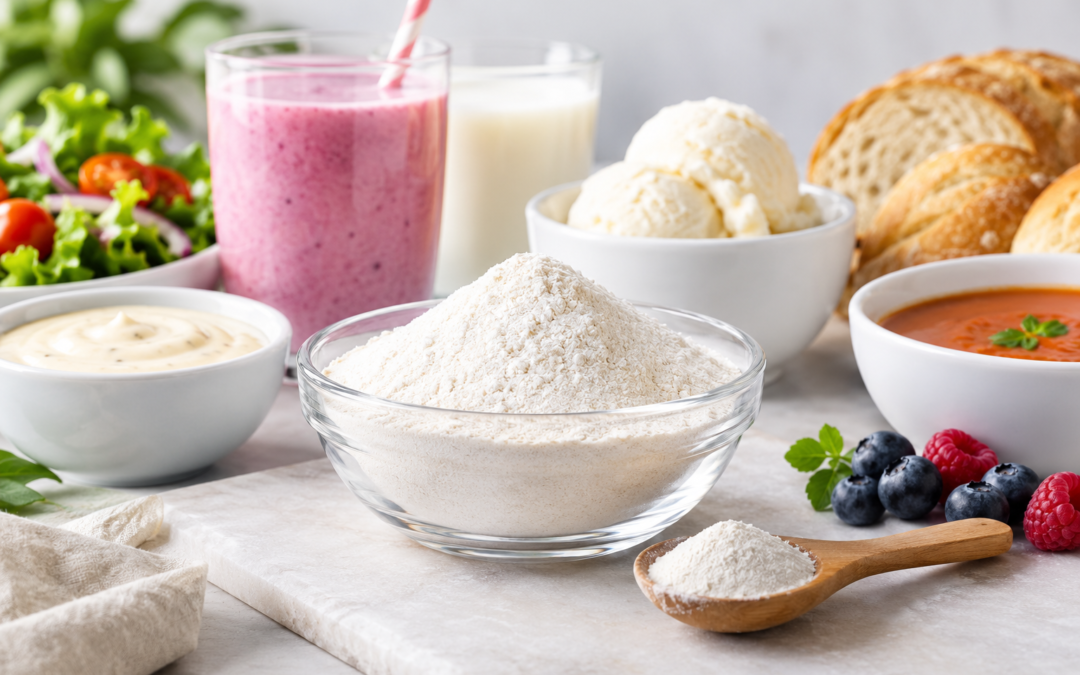
Xanthan Gum (C35H49O29)
Abstract
Xanthan gum (INS 415 / E415) is a microbial polysaccharide widely used in the food industry as a thickener, stabilizer, and texture modifier in sauces, dressings, beverages, dairy products, and bakery items. Its excellent viscosity and shear-thinning properties help improve product consistency and stability. According to Codex and EU regulations, permitted use levels depend on the specific food category and applicable conditions. EFSA concluded that there is no need to establish a numerical Acceptable Daily Intake (ADI) for xanthan gum.[1]
Introduction
Xanthan gum is a high-molecular-weight microbial polysaccharide produced by the fermentation of carbohydrates using Xanthomonas campestris. Following fermentation, the product is recovered, purified, and dried into a powder. Xanthan gum develops viscosity in both cold and hot water. Its shear-thinning behavior makes it useful in many food formulations because products can become easier to pour or pump under shear while maintaining body at rest.[2-3]
Chemical and Technical Characteristics [1-2]
| English Name | Xanthan Gum |
| Molecular Formula | C35H49O29 |
| CAS No. | 11138-66-2 |
| INS No. | 415 |
| E Number | E 415 |
| Main Functions | Thickener, stabilizer, and texture modifier |
| Appearance | White to cream-colored powder |
Why Is Xanthan gum Used in Food? [4]
Xanthan gum serves different functions depending on the food category, formulation, and concentration used.
- Sauces and dressings: Increases viscosity, reduces phase separation, and helps stabilize salad dressings, ketchup, and ready-made sauces.
- Beverages and fruit products: Helps suspend pulp and other particles, controls viscosity, and improves product uniformity.
- Ice cream and frozen desserts: Helps control water mobility, can reduce ice-crystal growth under suitable formulation conditions, and improves texture and storage stability.
- Bread and gluten-free bakery products: Helps improve dough cohesion, moisture retention, and the structure of the finished product.
- Soups, dairy products, and prepared foods: Provides thickening, helps maintain product stability, and improves mouthfeel.
Technical note: Xanthan gum is not necessarily the primary emulsifier in every product. It often improves stability by increasing the viscosity of the aqueous phase. The optimal dosage should be established through formulation trials.
International Food Additive Standards
The principal international references for xanthan gum in food applications are:
- Codex Alimentarius — GSFA (CXS 192-1995): Specifies permitted uses of xanthan gum (INS 415) by food category. Many permitted uses are listed under GMP (Good Manufacturing Practice), meaning that the additive should be used at the level necessary to achieve its intended technological function.
- European Union — E415: Regulation (EC) No 1333/2008 establishes the framework for food additive use, while Regulation (EU) No 231/2012 establishes specifications for food additives, including xanthan gum. Permitted use must be checked against the relevant food category.
- JECFA — FAO/WHO Expert Committee: Evaluates the identity, purity, and safety of xanthan gum. JECFA has established an ADI of “not specified.” This does not mean unlimited use is permitted; use must still comply with applicable regulations and Good Manufacturing Practice.
There is no single universal maximum use level for xanthan gum across all food products. Permitted levels depend on the food category, conditions of use, and the regulations of the destination market.[5]
Acceptable Daily Intake (ADI)
According to the Joint FAO/WHO Expert Committee on Food Additives (JECFA), the ADI for xanthan gum (INS 415) is “not specified,” meaning that a numerical ADI is not considered necessary based on the available safety assessment. In its 2017 scientific re-evaluation, the European Food Safety Authority (EFSA) also concluded that a numerical ADI was unnecessary and that xanthan gum did not raise a safety concern for the general population at the assessed exposure levels. This does not mean unlimited consumption is permitted; use must comply with Good Manufacturing Practice (GMP) and applicable food-category regulations. The EFSA assessment did not cover infants below 12 weeks of age.[6]
Safety, Purity, and Quality Control
Xanthan gum has undergone food-safety evaluations. However, selecting a suitable grade requires assessing both its technological performance and its quality specifications.
Key quality-control considerations include:
- Food grade: Confirmation that the product is suitable for food applications.
- Identity and purity: Compliance with applicable JECFA specifications or the recognized standards of the destination market.
- Viscosity: A defined viscosity result under specified concentration, temperature, preparation, and test conditions.
- Microbiological quality: Compliance with relevant microbiological requirements.
- Heavy metals and contaminants: Verification against applicable specifications and limits.
- Documentation: A Certificate of Analysis (COA), Technical Data Sheet (TDS), Safety Data Sheet (SDS), and batch traceability information.
JECFA publishes specifications for xanthan gum, and EFSA has conducted a re-evaluation of its safety. These documents can support supplier qualification and purchasing specifications.
What to Consider When Buying Xanthan gum?
- Food-grade quality: Ensure compliance with relevant international standards.
- Viscosity and performance: Choose the appropriate grade for your application.
- Purity and safety: Review the Certificate of Analysis (COA) and technical specifications.
- Regulatory compliance: Verify that the product meets the requirements of your target market.
- Reliable supply: Consider consistency between batches, packaging, shelf life, and supplier reliability.
Why Choose Our Xanthan gum?
Our high-quality, food-grade xanthan gum provides excellent thickening, stabilization, and texture control for a wide range of food applications, including sauces, dressings, beverages, dairy products, and gluten-free bakery products. We focus on consistent quality, reliable performance, and compliance with applicable food safety standards.
References
- EFSA Journal (2017) — Re-evaluation of Xanthan
- FDA — 21 CFR §172.695: Xanthan Gum
- PubMed — Research on xanthan gum properties and applications
- PubMed — Xanthan gum in food systems
- Codex GSFA Online Database
- Joint FAO/WHO Expert Committee on Food Additives (JECFA). Xanthan Gum — Safety Evaluation and ADI.
