
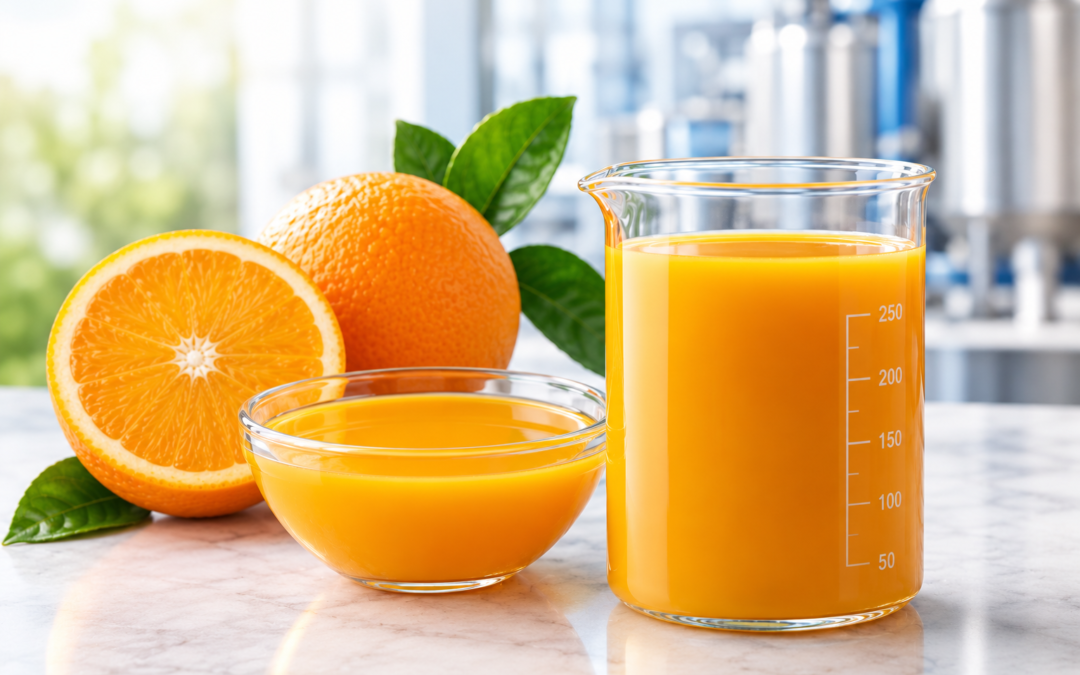
ORANGE JUICE CONCENTRATE IN THE FOOD INDUSTRY
Abstract
Orange juice concentrate is a high-solids ingredient used to provide orange flavour, colour, soluble fruit solids, acidity, and—in suitable formulations—some of the characteristic nutrients and aroma of orange juice. Its performance depends on more than °Brix: acidity, Brix-to-acid balance, flavour profile, colour, pulp/cloud behaviour, heat history, microbiological quality, packaging, storage, traceability, and legal suitability all matter. This review explains how concentrate is used across beverages and selected foods, why application rates must be calculated for each formulation, and how industrial buyers should assess a supplier specification. The supplied technical sheet for product LC03OE08521.1 describes a cloudy orange concentrate at 64–66 °Brix, acidity 3.3–3.75% (as citric acid, according to the sheet), pH below 3.8, aseptic filling, and refrigerated or frozen storage. These data suggest a highly concentrated ingredient potentially suitable for industrial dilution and flavouring, but the document does not establish every quality or regulatory attribute needed for every application. Importantly, the supplier explicitly states that the product is not according to the AIJN Code of Practice and that the buyer must verify local legal suitability. Therefore, it should be assessed as an application-specific ingredient—not automatically represented as universally compliant or as equivalent to standardised single-strength orange juice.
Keywords
Orange juice concentrate; 65 °Brix; cloudy concentrate; fruit beverages; formulation; Brix; acidity; AIJN; Codex Alimentarius; quality assurance.
1. Introduction
Concentrating orange juice removes a substantial proportion of water and increases soluble solids. This reduces the volume that must be stored and transported and allows manufacturers to standardise fruit-solids content when preparing beverages or using orange ingredients in compound foods. Concentrates are used in non-carbonated and carbonated drinks, fruit drinks, confectionery, bakery and culinary products, and other formulations where orange flavour or fruit-derived solids are desired [1,2].
A concentrate is not simply a sweetener or an orange flavour. It contributes a combination of sugars and other soluble solids, organic acids, aroma compounds, colour compounds and, depending on the product, cloud or pulp. Heating, oxygen exposure, storage temperature and packaging can alter volatile aroma and quality over time [1,2]. Product selection should therefore be based on the intended food, target sensory profile, process conditions and applicable law.
2. What makes a good industrial orange concentrate?
There is no single specification that makes a concentrate ideal for every industry. A beverage producer may prioritise natural orange flavour, Brix-to-acid balance, cloud stability and colour; a confectionery producer may prioritise soluble solids, acidity, flavour impact and compatibility with cooking; and a bakery manufacturer may prioritise consistent flavour through heating and predictable handling. A useful purchasing specification should include the following.
- Identity and composition: orange source, ingredient declaration, whether the product is cloudy or clarified, whether pulp is present, and whether any processing aids or standardising ingredients are used.
- Soluble solids (°Brix): a measure of soluble solids expressed as sucrose-equivalent refractive index. In fruit juice it is a practical formulation control, but it is not a direct measurement of orange juice percentage or total fruit authenticity by itself.
- Acidity and pH: titratable acidity describes the amount of neutralisable acid, while pH describes hydrogen-ion activity. Both affect flavour, preservation hurdles, gel behaviour and processing; they are not interchangeable.
- Brix-to-acid balance: helps predict sweetness–tartness perception. Two concentrates at the same Brix may taste different if their acidity differs.
- Flavour, aroma and colour: assess against an approved reference sample and, where relevant, use sensory evaluation and instrumental colour/volatile analysis.
- Cloud/pulp and physical stability: particle or pulp content, sedimentation, viscosity and redispersibility matter in cloudy drinks and some food systems.
- Food safety and authenticity: risk-based microbiological criteria, pesticide residues, contaminants, cleaning/sanitation controls, traceability and a batch-specific Certificate of Analysis (CoA).
- Processing and storage history: heat treatment, aseptic integrity, oxygen exposure, temperature history, package integrity and shelf-life evidence.
- Documentation: current specification, CoA for each lot, allergen/GMO/radiation statements where relevant, country of origin, storage and handling instructions, and documents supporting compliance in the destination market.
The AIJN Code of Practice provides reference guidelines used by the juice sector to assess juice identity, authenticity and quality; it is not a substitute for applicable legislation or a complete supplier-specific safety assessment [3,4]. Codex CXS 247-2005 sets international compositional and labelling principles for fruit juices and nectars, including reconstitution from concentrates [1].
3. Review of the supplied product specification
The supplied technical sheet is for LC03OE08521.1, described as “Orange Concentrate Cloudy 65brix”, review 04, dated 15 March 2025. The values below are transcribed from that document; they are supplier-declared specifications, not independent laboratory results.
| Parameter | Supplier specification | Industrial interpretation |
| Identity / composition | Orange 100%; product described as cloudy orange concentrate | Useful for orange-derived flavour and fruit solids. However, the sheet also notes citric acid may be used during processing to standardise the product; buyers should clarify how this is reflected in the ingredient declaration and target-market labelling. |
| °Brix | 64.0–66.0 | A concentrated, high-solids ingredient suitable for controlled dilution or use at low inclusion levels in compound foods. |
| Acidity | 3.3–3.75% (a.c.a.; as stated in sheet) | Relevant to tartness and formulation. Confirm the test method and whether the result is expressed as anhydrous citric acid. |
| pH | <3.8 | Acidic product; pH alone does not establish microbial safety or shelf stability. |
| Total plate count | <1 CFU/mL | A very low stated limit. Request method, sampling plan, detection/quantification limit and lot-specific CoA to interpret the result correctly. |
| Yeasts / moulds | Each <1 CFU/mL | Potentially useful microbiological control, but it does not replace a risk-based food-safety plan or validation of aseptic processing. |
| Composition | Orange 100% | The sheet separately states that citric acid may be used during processing to standardise the product; obtain written clarification. |
| Filling / package | Aseptic; 250 kg metal drum, inner aluminium-laminated bag and outer PE protective bag | Aseptic filling and a barrier liner can support bulk handling, provided seals, drums and handling practices maintain integrity. |
| Storage / shelf life | Refrigerated 4–10 °C: 12 months; frozen −18 °C: 24 months | Follow the stated temperature conditions and confirm whether the shelf life applies to unopened packs. Define post-opening handling with the supplier. |
| Nutrition per 100 g | 250 kcal; carbohydrate 57.3 g; sugars 51.4 g; fibre 1.7 g; protein 2.1 g; fat 0.1 g; sodium 4.1 mg | Use as supplier-provided values only. For nutrition labelling or nutrient claims, verify with analytical data and local rules. |
| Allergens / GMO / irradiation | No Annex II allergens stated; non-GMO statement; not irradiated | Helpful declarations, but obtain current signed statements and verify applicability to the intended market. |
| Pesticides / contaminants | States compliance with EC 396/2005 and EC 2023/915, as amended | Request current supporting documentation and batch/risk-based test results when required by the buyer’s quality programme. |
| AIJN status | Supplier explicitly states: “The product is not according AIJN.” | Important limitation: do not describe it as AIJN-compliant. Confirm whether this matters for the specific finished product, customer contract or market. |
3.1 Overall assessment: how close is it to an ideal concentrate?
The product appears strong on concentration, declared low microbiological counts, aseptic bulk packaging, defined cold/frozen storage and several supplier declarations. These characteristics can be commercially useful for manufacturers that need a high-solids orange ingredient and can maintain the cold chain. Nevertheless, the specification is not sufficient to conclude that the product is “ideal” for every application. It does not provide, in the supplied pages, a complete profile of aroma/volatile compounds, colour, pulp content, cloud stability, Brix-to-acid ratio, vitamin C at end of shelf life, heat history, detailed authenticity markers, analytical methods for each parameter, or a batch-specific CoA. Most importantly, the supplier states that it is not according to AIJN [specification]. It may still be suitable for some uses, but this must be determined by the buyer’s product requirements and the applicable rules.
A point requiring written clarification is the combination of “Orange 100%” with the note that citric acid used in part of the process to standardise the product may have different origins depending on the season. Ask the supplier whether citric acid remains in the final ingredient, how it is declared, whether it changes the product’s legal identity for the target use, and whether the nutrition and acidity values include that standardisation.
4. Why orange concentrate is added to foods
Orange concentrate is used to achieve one or more technological and sensory objectives: orange flavour and aroma; orange colour; soluble fruit solids; sweetness and acidity balance; a fruit-juice component in beverages; and a consistent ingredient that can be dosed by weight. It may also contribute naturally occurring sugars, acids and micronutrients, but their retained levels vary with raw fruit, concentration, heat treatment and storage. Do not assume a specific vitamin C level unless it is specified and verified.
4.1 Main food applications
- Ready-to-drink (RTD) orange juice and reconstituted juice: concentrate plus potable water, with any permitted ingredients, is adjusted to the required soluble-solids level and sensory profile. Reconstitution should follow the applicable standard and labelling rules [1,5].
- Fruit drinks, nectars and juice blends: used to supply orange character and fruit-derived soluble solids. The amount depends on the legal category, required fruit content, target Brix/acidity, sweetness, and whether other juices or ingredients are present.
- Carbonated and still soft drinks: provides orange flavour, acidity and soluble solids; the formula may also need sweetener, acidulant, stabiliser, flavour, colour or clouding ingredients. Compatibility and label declarations must be checked [2].
- Sports, hydration and functional beverages: used primarily for flavour and acid–sweetness balance. Electrolytes, vitamins or functional ingredients are separate formulation decisions and should not be assumed to be supplied at meaningful levels by the concentrate.
- Dairy and plant-based drinks: can provide a citrus note, but low pH may destabilise proteins and cause aggregation or separation. Use a validated formulation strategy, controlled addition order and pilot trials.
- Yoghurt, fermented dairy, sauces and dressings: acidity and citrus flavour can be useful, but protein stability, emulsion stability, heat treatment and microbial control require product-specific testing.
- Confectionery, gummies, jellies and fillings: flavour and acid contribute to sensory profile; acidity can influence pectin/gelatin systems and setting behaviour. Solids and moisture must be recalculated.
- Bakery, cakes, biscuits, fillings and icings: adds orange flavour and some acidity/moisture. Heat can reduce fresh aroma, so sensory assessment after baking is necessary.
- Frozen desserts, sorbets and ice pops: contributes fruit flavour, soluble solids and acidity; Brix affects freezing behaviour and texture, so the whole recipe must be balanced.
- Marinades, sauces and culinary products: provides citrus flavour and acidity. It is not a validated substitute for a designed acidification or preservation step.
5. How much should be added? Practical formulation guidance
There is no universal inclusion rate for orange concentrate. The correct level depends on the food category, the legal minimum fruit content (if applicable), the desired flavour intensity, final Brix, acidity, sweetener system, processing losses and cost target. A supplier statement such as “recommended dosage for 1000 L RTD: use as such” is ambiguous unless the supplier confirms whether it means the concentrate is supplied as an ingredient for a customer-specific RTD recipe or gives a defined dilution instruction. Do not interpret it as a complete, ready-to-drink formulation without written confirmation.
5.1 Reconstitution calculation example
For an initial mass-balance estimate, if a concentrate is 65 °Brix and the target soluble solids of the reconstituted juice are 11.2 °Brix, a simplified calculation is:
Concentrate fraction ≈ target °Brix ÷ concentrate °Brix = 11.2 ÷ 65 = 0.172
This corresponds to approximately 17.2 kg of 65 °Brix concentrate per 100 kg of final mixture, before accounting for density, pulp, non-sucrose soluble solids, acid correction, sensory adjustment and any other ingredients. For a 1,000 kg final batch, the first-pass estimate is about 172 kg concentrate, with potable water and other ingredients making up the balance. This is a calculation example—not a universal legal recipe. The Codex standard requires reconstituted juice to meet the relevant minimum Brix level for the fruit, and local rules may differ [1]. Confirm the required target with the customer, standard and market.
For compound beverages, use bench trials and a formulation sheet. Record concentrate mass, water mass, final Brix, pH, titratable acidity, sensory result and stability. Do not dose by volume alone unless density has been measured or reliably specified.
5.2 Practical starting points for non-juice products
For soft drinks, dairy drinks, confectionery, bakery and sauces, a single recommended percentage would be misleading because product systems differ greatly. Start with small bench-scale trials at several levels selected by the product developer, then choose the lowest level that meets flavour and fruit-content targets without causing excessive acidity, instability or cost. If a numerical starting range is needed for a specific product, it should be developed from the current recipe, target label claim and sensory benchmark rather than treated as a general standard.
6. Quality changes during processing and storage
Orange aroma is partly supplied by volatile compounds that may be lost or changed during concentration, heating, oxygen exposure and storage [2]. High temperature and long holding times can also affect colour and flavour. For cloudy concentrates, pulp/cloud can settle or change in appearance; this is not automatically a defect, but the acceptable level and redispersibility should be agreed in the product specification.
- Use the supplier’s stated storage conditions: 4–10 °C for refrigerated storage or −18 °C for frozen storage, with stated shelf lives of 12 and 24 months respectively for this product.
- Maintain temperature records through receipt and storage; inspect drum seals, liner integrity, leakage, swelling, unusual odour and visible contamination.
- Minimise unnecessary oxygen exposure and repeated warming/freezing. Follow the supplier’s thawing and post-opening instructions.
- Validate the finished product’s heat process, filling system, pH, packaging and shelf life. Low pH and a low plate count in the concentrate alone do not prove that a finished beverage is microbiologically safe.
- Use a planned shelf-life study that includes sensory checks, Brix, pH, titratable acidity, colour, cloud/sedimentation where relevant, microbiology and nutrients or aroma markers if claimed.
7. Standards, legal suitability and safety
Three distinct questions should be separated: (i) whether the ingredient meets the supplier’s own specification; (ii) whether it is consistent with an industry reference guideline such as AIJN; and (iii) whether the ingredient and the finished food comply with the law of the country where they are manufactured and sold.
Codex CXS 247-2005 is an international reference for fruit juices and nectars, including composition and reconstitution principles [1]. AIJN publishes reference guidelines used by the juice industry to evaluate juice quality, identity and authenticity [3,4]. Neither source should be used to claim that this particular commercial concentrate complies when its own specification explicitly says it is not according to AIJN. Codex standards are not automatically national law; their legal status depends on local adoption.
The supplier sheet states that the product and its ingredients conform to Spanish or European food-law requirements, references EU pesticide-residue and contaminant regulations, and says the user is responsible for confirming suitability under local law. This is a supplier declaration, not an independent certification of every batch or every intended use. For beverage use, juice safety controls and a documented hazard analysis are important; FDA guidance, for example, explains the role of HACCP controls for juice and juice concentrates intended for beverage use in the United States [6]. Requirements vary by jurisdiction.
Before commercial approval, confirm the exact legal category and label name; permitted ingredients and processing aids; fruit-content rules; microbiological and chemical criteria; pesticide and contaminant compliance; packaging food-contact suitability; traceability; and whether the customer contract requires AIJN conformity. Do not claim “meets all international standards” on the basis of this two-page sheet.
8. Is this concentrate worth purchasing? Potential customer benefits
For an industrial customer whose formulation accepts this specification, the product may offer the following practical advantages:
- High concentration (64–66 °Brix), allowing controlled dosing and reducing the quantity of water transported compared with single-strength juice.
- Declared orange-only composition, subject to clarification of the processing note concerning citric acid and final ingredient declaration.
- Aseptic bulk packaging designed for industrial handling.
- Defined refrigerated and frozen storage conditions and stated shelf life.
- Low stated plate-count, yeast and mould limits, which can support incoming-quality specifications when backed by a batch-specific CoA and validated methods.
- Supplier declarations concerning allergens, GMO status, irradiation, pesticides and contaminants, which can streamline initial supplier qualification if current evidence is provided.
- Potentially predictable formulation and procurement, provided each delivery meets agreed Brix, acidity, flavour and microbiological criteria.
These are potential procurement advantages, not proof that the product is better than competitors. The economic comparison should use cost per kilogram of soluble solids or cost per litre of finished beverage at the target specification, while also accounting for cold storage, freight, losses, rework risk, sensory performance and documentation costs. A cheaper concentrate may not be cheaper in use if it requires higher inclusion, correction of acidity, extra flavour, or more stringent quality controls.
9. Recommended buyer approval checklist
- Request a current batch-specific Certificate of Analysis (CoA), including Brix, titratable acidity, pH, microbiology and any agreed sensory/colour/cloud measures.
- Ask for analytical methods, sampling plan, detection limits and acceptance criteria for the stated <1 CFU/mL microbiological results.
- Clarify in writing the “Orange 100%” statement versus the note that citric acid may be used for standardisation; confirm final composition and legal ingredient declaration.
- Request process information relevant to safety: validated processing/aseptic filling, HACCP or equivalent food-safety system, and any relevant audit/certification documents.
- Obtain pesticide-residue and contaminant documentation appropriate to the destination market and risk profile.
- Request information on pulp/cloud, colour, flavour profile, heat history, Brix-to-acid ratio and any available authenticity data.
- Confirm food-contact compliance for the metal drum and inner liner, seal integrity, traceability and recall procedures.
- Agree storage, transport temperature, unopened shelf life, thawing instructions and post-opening use period.
- Run a pilot trial in the actual recipe, including sensory evaluation and stability after the real process.
- Approve only against a written product specification and a defined use case; re-evaluate if the target market or recipe changes.
10. Conclusion
Orange concentrate is a versatile industrial ingredient that can deliver orange flavour, acidity, colour and concentrated fruit solids in beverages and a range of compound foods. Its use level must be calculated for the intended product rather than copied from a universal dosage table. For reconstituted juice, Brix mass balance is a useful first step, but final composition and legal requirements must be verified against the relevant standard and market.
The supplied LC03OE08521.1 specification describes a cloudy concentrate at 64–66 °Brix, with declared acidity of 3.3–3.75%, pH below 3.8, low stated microbiological counts, aseptic bulk packaging and defined refrigerated/frozen shelf life. These are useful starting attributes for industrial evaluation. However, the document does not provide a complete analytical profile, and it explicitly states that the product is not according to AIJN. The note about citric acid standardisation should also be clarified. Therefore, the strongest purchasing recommendation is conditional: buy the ingredient when its actual batch, sensory performance, documentation, storage chain, cost-in-use and legal suitability meet the requirements of the specific finished food. A batch-specific CoA and successful pilot trial are essential before routine production.
References
[1] Codex Alimentarius Commission. (2005; subsequent amendments as applicable). CXS 247-2005: General Standard for Fruit Juices and Nectars. FAO/WHO. https://www.fao.org/input/download/standards/10154/CXS_247e.pdf
[2] ScienceDirect Topics. Juice Concentrate. Overview of concentrate use, composition and aroma-related considerations. https://www.sciencedirect.com/topics/agricultural-and-biological-sciences/juice-concentrate
[3] European Fruit Juice Association (AIJN). The AIJN Code of Practice. https://aijn.eu/en/the-aijn-code-of-practice
[4] AIJN. Orange: Reference Guideline for Orange Juice. https://aijn.eu/en/reference-guidelines/oranges
[5] Tetra Pak. Orange Book: Standards and Regulations; and Orange Juice Quality and Categories. https://orangebook.tetrapak.com/chapter/standards-and-regulations ; https://orangebook.tetrapak.com/chapter/orange-juice-quality-and-categories
[6] U.S. Food and Drug Administration (FDA). Guidance for Industry: Juice Hazard Analysis Critical Control Point Hazards and Controls Guidance, First Edition. https://www.fda.gov/regulatory-information/search-fda-guidance-documents/guidance-industry-juice-hazard-analysis-critical-control-points-hazards-and-controls-guidance-first
[7] Lemon Concentrate S.L. (2025). Product Technical Specification LC03OE08521.1: Orange Concentrate Cloudy 65brix, version LC04, review 04, review date 15 March 2025. Supplier-provided technical data sheet (two pages).
Important scope note
This review is an educational and technical purchasing aid, not a certification, legal opinion, or substitute for testing. Product-specific numerical values attributed to LC03OE08521.1 come from the supplied technical sheet. General formulation and regulatory discussion is supported by the references listed above. Before making a label claim or placing the product on a market, obtain current supplier documentation and verify applicable national requirements.
